
Jailhouse Rock made a hero out of a convicted killer and turned him into a music icon while asking audiences to root for him. I’m not sure a studio today would take that risk, which is exactly why Jailhouse Rock is still worth watching and talking about. It’s also important to remember that context is king and movies are products of their time, giving us a view into the ideas, hopes, and issues that shaped our past.
So, let’s turn back the clock to 1957 for this review of Jailhouse Rock, starring Elvis Presley, the King of Rock and Roll, in honor of his birthday, which was on January 8th and is ironically, my birthday, too.
Jailhouse Rock is a quick one hour and thirty-six minutes and came out in 1957, which feels like a lifetime ago. While lots of people might have heard of the film because of the song, I think most people just think of it as a kitschy romantic Elvis romantic romp rather than a somewhat revolutionary film for its time. The question is, how well does it hold up seven decades later?
You can read the review below or watch the video review on YouTube:
Elvis plays Vince Everett, a young man convicted for accidentally killing a man while trying to protect a woman. His cellmate, a long-time convict named Hunk Houghton, is also a former country music singer who schools Vince on how prison life works and eventually teaches him how to play the guitar. After a jailhouse talent show, Hunk realizes that this kid has a special talent and gets Vince to sign a contract to play music together once they both get out of prison.
Vince gets out of jail first and looks up one of Hunk’s old contacts for a job, which is where he meets Peggy, who helps him make a new life for himself in music and film. Together they start a small record company and Vince finds himself navigating sudden success, romance, and everything that comes with it.
First Impressions Looking Back
Jailhouse Rock is a look back in time at a romanticized version of the America that we imagined for ourselves in this thriving post war era full of opportunity. The film embraces a predictable plot with Vince’s rise to musical stardom plus a traditional love story that feels in line with the romantic ideals of the time, but don’t let it fool you. There’s more to the story than you think.
The formula works because it hits all the key points in predictable ways just like you expect, and that’s surprisingly satisfying, largely because of Elvis himself. When you take the film for what it was doing in the ’50s, you start to realize it was much edgier and more subversive than it appears. It’s that surface level cookie cutter appearance paired with Vince’s rebellious appeal and Peggy’s wholesome character that hide the sharper social issues that are easy to gloss over but are still present today.
The Characters and Why They Work
The film focuses primarily on Vince, Peggy, and Hunk, who each bring a different perspective to the story and help drive it forward.
Vince Everett works because he isn’t yet fully formed as a man. He wants love, he wants success, and he wants the girl, but he doesn’t really understand how to be the person he needs to be to make any of that last once he has it. His story kicks off by showing how impulsive and stubborn he is, which is largely why he ends up in jail for manslaughter, and the result of that struggle leaves him emotionally immature in ways that make sense for where he is in his life. Watching Vince struggle isn’t frustrating because it feels honest, and we understand why there is this strong push and pull between him and Peggy. He’s learning in real time with no safety net and nobody to mentor or guide him, which forces him into the school of hard knocks.
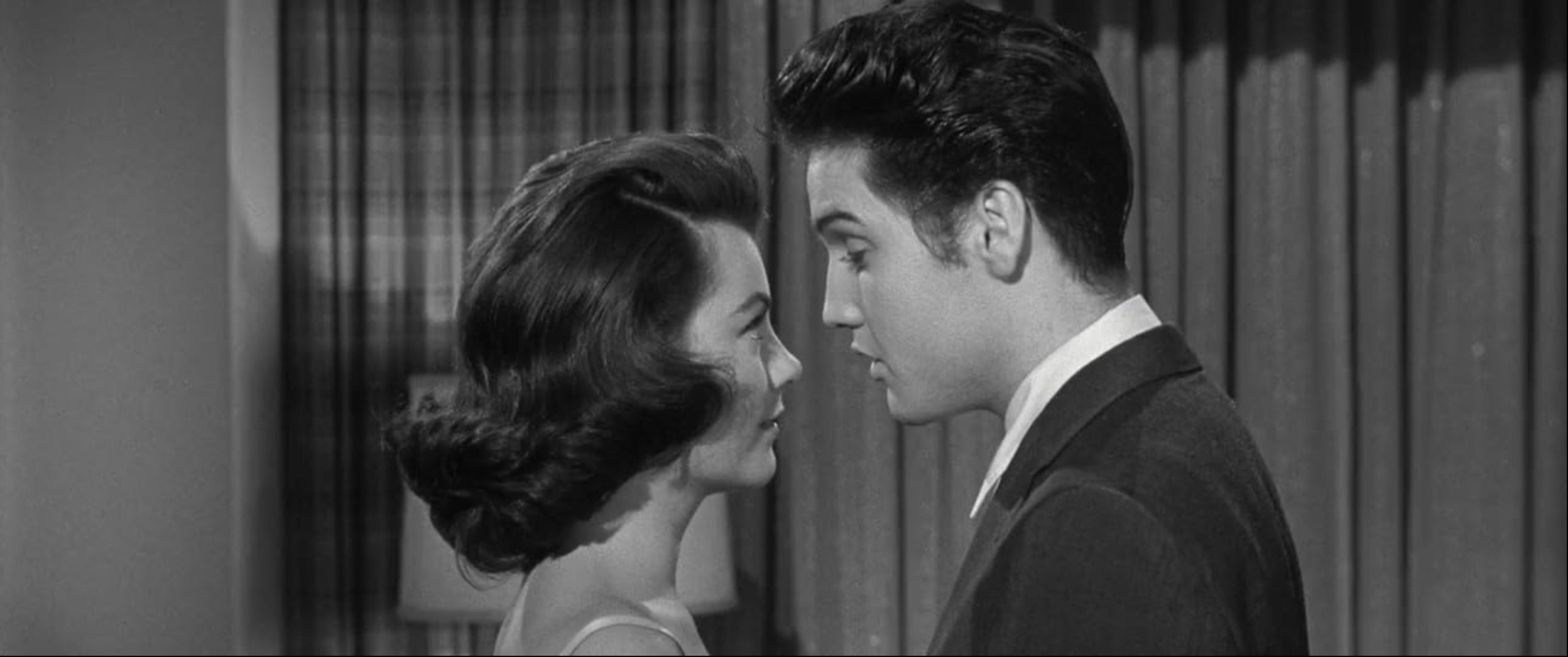
Peggy is Vince’s love interest, but she’s also his north star. They take a chance on each other as business partners, and so much of what Vince wants in life is tied up in her. She’s beautiful, smart, and self-assured. She’s the whole package, which immediately makes her stand out as a 1950s female character who is soft and feminine while also having standards and a desire to be in a healthy, loving relationship. While Vince and Peggy are clearly in love, his impulsiveness and sense of entitlement make her pause, and that pause makes him think she isn’t interested in him. The thing is, she just doesn’t want to be part of the parade of women who pass through his life.
Finally, we have Hunk, the man who was on the cusp of making it big in music before he ended up in prison. He’s tasted success and failure, and when he meets Vince, he sees something in this young man that reignites his own hope for the future. He takes Vince under his wing and helps him get through prison life, because Hunk is savvy enough to see that Vince is a path to recovering his own future. While Vince is a naive and brash, he also realizes that Hunk is saving him in prison, and their bond becomes a lifeline for them both. Even though Vince knows that Hunk tried to take advantage of his musical talent with the contract, he still can’t abandon Hunk when the older man needs him.
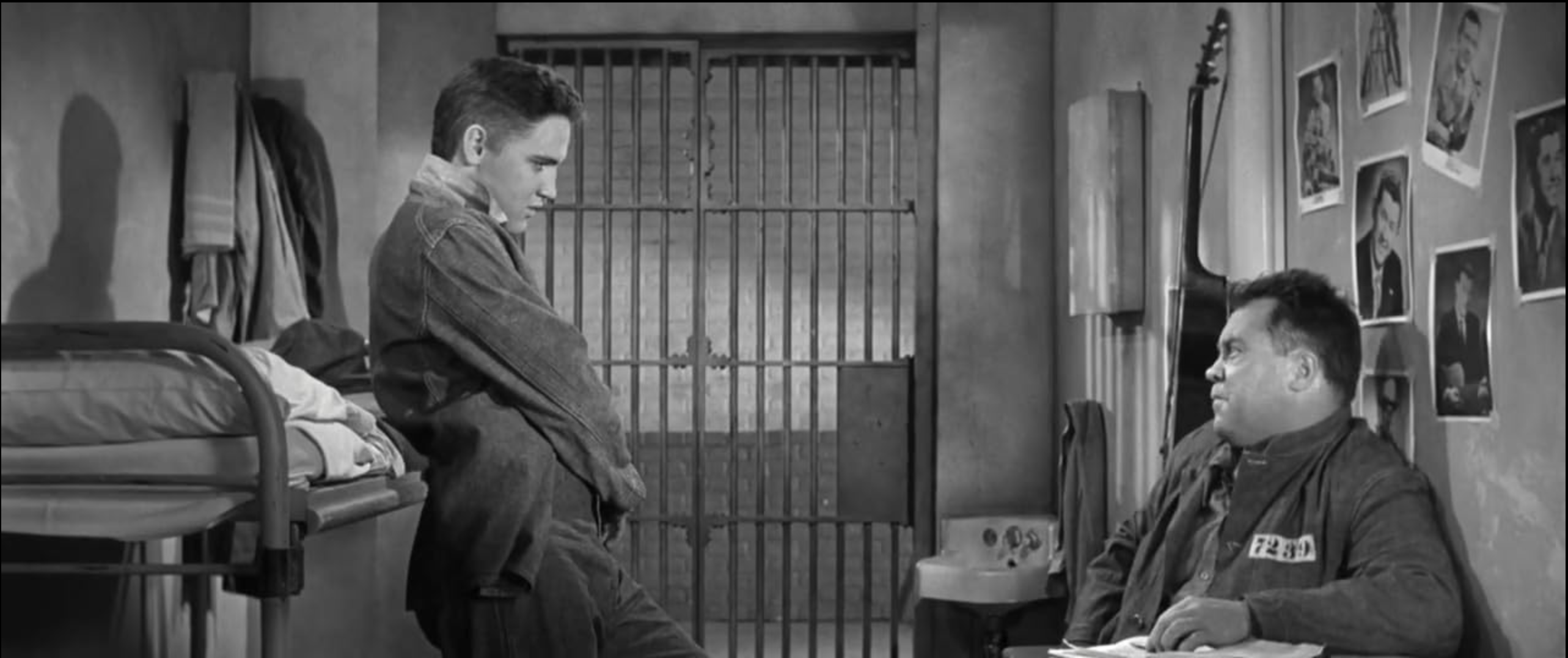
Together, these three characters form a strong, balanced trio, with Hunk as the mentor from the past, Peggy as the guide to the future, and Vince as the young hero whose redemption arc isn’t quite as compelling as his smile.
Why Jailhouse Rock is Still Important Today
I love Elvis, but he isn’t the most compelling actor. Still, when it comes to music, he can perform with the best of them. Plus, there is no doubt that he’s a charismatic force of nature when he’s on screen. Even seventy years later, his performance in Jailhouse Rock is no exception. However, for a modern audience looking at the movie from today’s perspective, there are things that may keep people from fully connecting with the story. While this isn’t a flaw, the black and white nature of the film is likely to turn off younger audiences who are used to vibrant color, layered textures, and depth of field in movies today.
Where Jailhouse Rock gets really interesting is when you view the film from today’s perspective while also keeping the issues and standards of the 1950s in mind, because that’s when you start to see where it pushes the boundaries of the time. When you watch an older film like this, you get so much more out of it when you recognize the conversation taking place between what the filmmakers were doing with the story in 1957 and what the audience is experiencing as social norms today. It’s that juxtaposition between the cookie cutter, perfect version of the past and the world-weary present that shows you just how edgy this film really was for its time. If you only take it at the surface level, the story is little more than a glossy relic of a past that never existed.
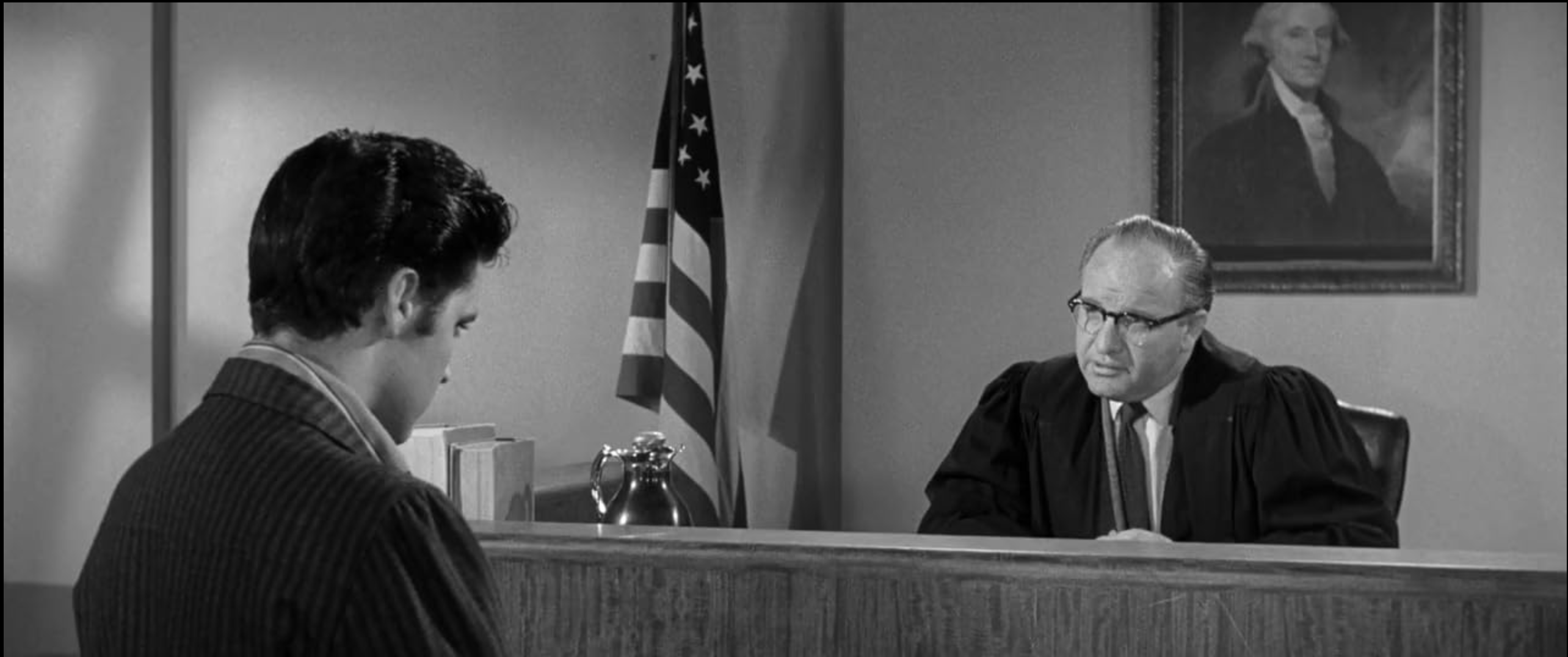
However, if you peel away the Hollywood glaze, you get a young man who accidentally killed a man and went to prison for his crime. His life behind bars wasn’t easy, and his hot-headed responses to problems usually gets him into more problems than solutions. Other than the “Jailhouse Rock” performance on live TV, the 1957 film largely avoids dealing with the consequences of Vince’s past once he rises to fame. In contrast, if the film were made today, it would absolutely address the fact that he was convicted of manslaughter as well as what that would mean for someone who is rising to fame since that tension would be the core of his redemption arc. Instead, that tension is only lightly touched on and only after Hunk joins Vince on the road.
As for the love story, the structure of how Vince and Peggy meet, start a business together, fall in love, break apart, and ultimately come back together still works today. The only real difference is that Peggy has enough experience with musicians to know how easy it is to get pulled into a casual relationship, even though we never see where or how she gained that experience. What we see is Peggy choosing to avoid a relationship with Vince when he automatically expects her to be his girl. Instead, she holds that line until she sees him choose her and gives her the space to choose him, too. Part of that romantic connection comes from the mastery of his emotions. He’s grown up while they were apart, and part of that is due to Hunk’s guidance.
Music, Performance, and Visual Style
What really works is how the film shows Vince’s musical evolution. Not only does he grow as a person, he transforms as a performer who learns from both Hunk and Peggy in different ways as he finds his unique style and hones his craft. That’s when the Elvis we know emerges.
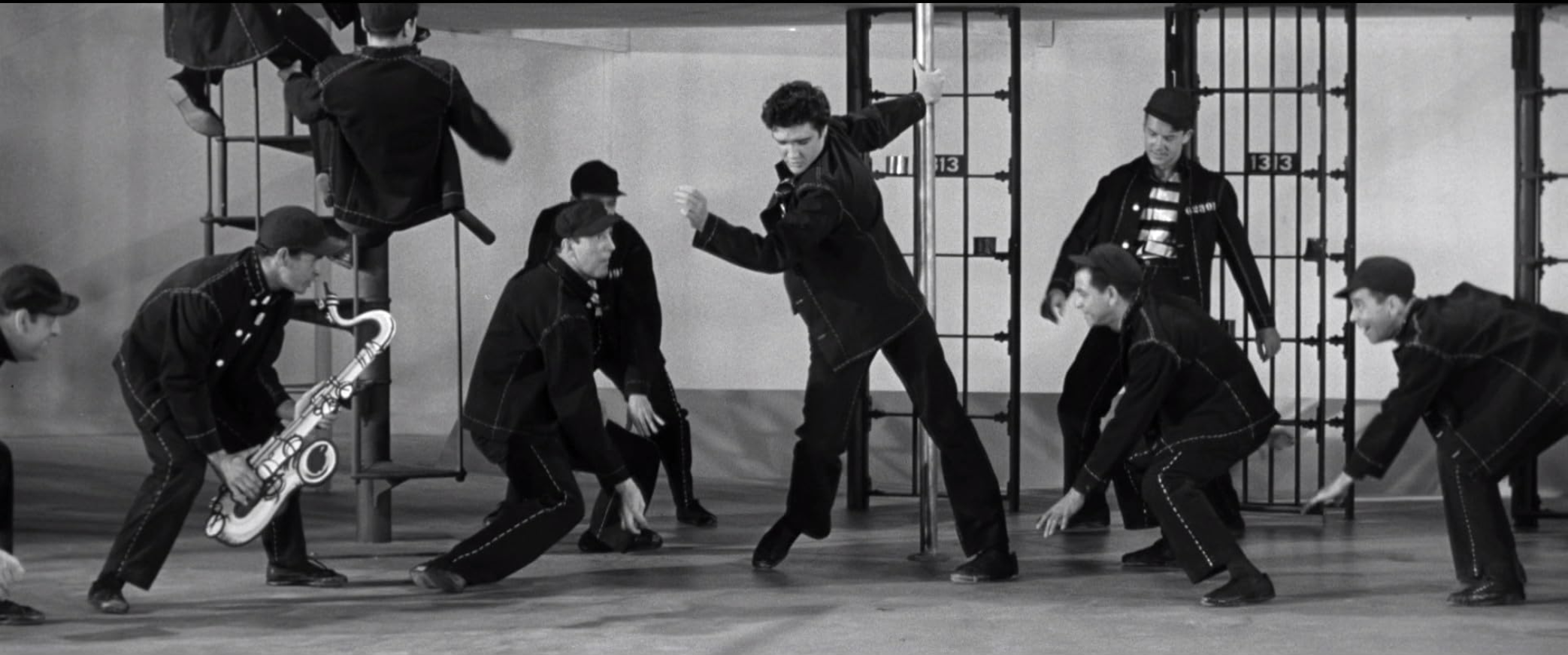
There are seven songs in Jailhouse Rock, most performed by Elvis, but the standout performances are obviously “Jailhouse Rock,” “You’re So Square,” and “Young and Beautiful.” However, it’s the title song that makes the film iconic, keeping it from being just another forgettable musical romance and turning it into a moment of cinematic history. While the visual style of the film is pretty standard for the 1950s, it’s the artistic and strategic vision of the “Jailhouse Rock” scene that shows Elvis’ talent as a performer and that scene is a work of cinematic art that embraces the limitations of black and white filmmaking.
With light and shadow, the song starts out with cell block and prisoners in silhouette before stepping into the light wearing their blacks and whites with Elvis shaking, dancing, and singing. Looking back at this performance and the way they filmed it, I think that if a modern director where to film it today, I think very little would be different in this number, which speaks to the timelessness of the song as well as the scene and why it serves so well as the heart of the story. It’s hard to imagine it working as well if it were filmed color.
Recommendation
Is Jailhouse Rock stream-worthy? Yeah, I think so, especially if you like understanding where we are today through the historical lens of iconic films. The story still stands up today, even if it’s a bit predictable and the cinematic storytelling is different than what we get today. A younger audience may struggle with that at first, especially with the black and white cinematography, but if they give it a chance.
In fact, Jailhouse Rock is a great film choice that cuts across generations as well because Elvis still has lasting star power and can give kids, parents, and grandparents something to watch and talk about together. Plus, Elvis feels authentic in this film. No, he wasn’t a convict, but there’s something sincere in this role that aligns with his own life and experiences. There’s a struggle here that I think we can all identify with at some level from his personal struggles to his success and desire for love.
Final Thoughts
Before I close, there’s one last thing I need to mention about that final set of scenes. In the confrontation with Hunk, Vince finally sees himself clearly, mirroring the opening act. His story starts out with his hot-headed instinct to step in and defend a woman who was being abused, and that choice leads him to cross a line, accidentally killing a man with one punch. When Hunk confronts him about how he’s treating Peggy and strikes him, Vince doesn’t fight back. It’s in that moment that he recognizes how similar he’s become to that man he killed. That’s when he chooses a different path.
It’s that choice, knowing he could stop Hunk but doesn’t risk it that completes his redemption arc. As much as the film may visually read like a simple and predictable plot, when you really look at Jailhouse Rock, it isn’t surface-level storytelling. There are deep and complicated thoughts in this story that are just below the surface, if you are willing to look. That’s why it continues to set itself apart from other films of the era and remain relevant even seventy years later. So, what do you think about Jailhouse Rock? Have you seen it? Are there other Elvis films or songs that you love?
If you enjoyed this review, please give it a like and subscribe for more. You can also visit my YouTube channel at @ErinUnderwood for more videos.



 Erin Underwood Presents