Doc

DOC (aka The Doctor Underwood)

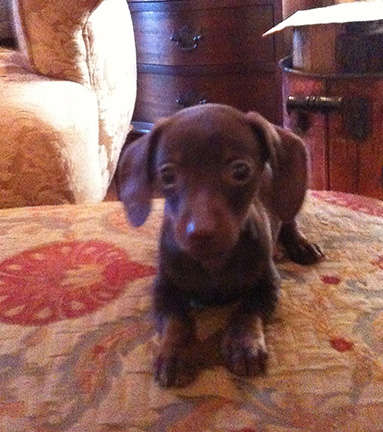
If you’re wondering where the blog posts have gone…. well, the puppy ate them! Yes, Underwords has a new puppy and his name is Doc. Yes. Doc as in The Doctor (aka The Doctor Underwood), but we call him Doc for short.

He’s a miniature dachshund whose parents are on the smaller side. He’s about 11 weeks old right now, and I think he’s finally grown beyond the “teacup” size into a solid “coffee mug”. He’s a really beautiful chocolate brown with splashes of golden color on his paws and nose. Clearly, it looks like he jumped into a honey pit.

So, I thought you might enjoy meeting the new puppy so that you all know where my blogging time has gone. I promise more blogging about all things SF, fantasy and horror will be starting again soon….

In the meantime, here are a few photos of Doc for your viewing enjoyment:

Zippymale1rs

This was the first photo of Doc when he was maybe a few days old. Tom said he looked a bit like a tinsy tiny werewolf, which convinced me that Doc would be right at home with the Underwoods.

Doc 3

This is Doc today. He is standing upon the living room ottoman, surveying his new kingdom and wondering where he put that little dinosaur toy that he loves.

Doc 4

Here’s Doc in a moment of quiet reflection as he ponders the great questions of the day … i.e. When will breakfast be served? …. Where did that dinosaur toy go? …. How did I get on the ottoman? …. I think I see the CAT!

Doc 1

Here we have Doc petitioning Lucky, the current reigning Queen of Hawkes Street, as he requests a few minutes of time with her blue snowman toy.

I hope you’ve enjoyed meeting Doc. I’m sure you’ll see pictures of him cropping up here and there in the future.

Posted on by Erin Underwood | 3 Comments

2012 Year-End: Time of the Hollywood Blockbusters

For awhile I thought that 2012 was likely to be a dud for the big Hollywood blockbusters. Throughout the bulk of the year, Hollywood has only released a scattering of great films, and the big hitters seemed to be few and far between. However, some of the best films of 2012, so far, include The Hunger Games, The Dark Knight Rises, and Avengers. Snow White and the Huntsman promised to be one of the great films of 2012, but turned out to be be a disappointment in the story department despite being a showcase for gorgeous cinematography on screen. John Carter was even more disappointing. Then comes November and December and you can almost hear Hollywood commanding, “Let loose the krakens!” as we close in on 2012.

In the final two months of the year, Hollywood is releasing the kind of movies that compel people to leave their Pay-Per-View Palaces and plunk down cold hard cash to view films the way they were meant to be seen–on the BIG screen–in theaters.

Here’s a list of year-end films that are likely to be 2012 blockbusters. Some of these titles are already in theaters while others are “coming soon.” Argo is a fantastic film that brilliantly builds suspense and drama despite the audience knowing the ending. It’s a great film that is built upon a solid script, terrific actors and smart directing. Twilight: Breaking Dawn is a solid end to the Twilight series. The cinematography is absolutely gorgeous and the script has some surprising twists, twists that feel so natural that (while you will be utterly surprised by some of the action) you won’t begrudge the director the deviation from the story.

As for the rest of the remaining films of 2012, I’m on a week-by-week quest to see each one on the big screen. Now, all I need is a bucket of buttered popcorn, a diet Coke, and half a dozen move tickets.

IN THEATERS NOW

Argo
On Nov. 4, 1979, militants storm the U.S. embassy in Tehran, Iran, taking 66 American hostages. Amid the chaos, six Americans manage to slip away and find refuge with the Canadian ambassador. Knowing that it’s just a matter of time before the refugees are found and likely executed, the U.S. government calls on extractor Tony Mendez (Ben Affleck) to rescue them. Mendez’s plan is to pose as a Hollywood producer scouting locations in Iran and train the refugees to act as his “film” crew. (description from Fandango.com)

Twilight: Breaking Dawn
Bella (Kristen Stewart) awakes — as a vampire — from her life-threatening labor, and her newborn daughter, Renesmee, proves to be very special indeed. While Bella adjusts to her new state of being, Renesmee experiences accelerated growth. When the Volturi learn of the baby’s existence, they declare her to be an abomination and sentence the Cullens to death. Bella, Edward (Robert Pattinson) and the rest of the clan seek help from allies around the world to protect their family. (description from Fandango.com)

Lincoln
Steven Spielberg directs two-time Academy Award® winner Daniel Day-Lewis in “Lincoln,” a revealing drama that focuses on the 16th President’s tumultuous final months in office. In a nation divided by war and the strong winds of change, Lincoln pursues a course of action designed to end the war, unite the country and abolish slavery. With the moral courage and fierce determination to succeed, his choices during this critical moment will change the fate of generations to come. (description from Fandango.com)

Skyfall
When James Bond’s (Daniel Craig) latest assignment goes terribly wrong, it leads to a calamitous turn of events: Undercover agents around the world are exposed, and MI6 is attacked, forcing M (Judi Dench) to relocate the agency. With MI6 now compromised inside and out, M turns to the one man she can trust: Bond. Aided only by a field agent (Naomie Harris), Bond takes to the shadows and follows a trail to Silva (Javier Bardem), a man from M’s past who wants to settle an old score. (description from Fandango.com)

Life of Pi
After deciding to sell their zoo in India and move to Canada, Santosh and Gita Patel board a freighter with their sons and a few remaining animals. Tragedy strikes when a terrible storm sinks the ship, leaving the Patels’ teenage son, Pi (Suraj Sharma), as the only human survivor. However, Pi is not alone; a fearsome Bengal tiger has also found refuge aboard the lifeboat. As days turn into weeks and weeks drag into months, Pi and the tiger must learn to trust each other if both are to survive. (description from Fandango.com)

NOVEMBER 23

Hitchcock
Following his great success with “North by Northwest,” director Alfred Hitchcock (Anthony Hopkins) makes a daring choice for his next project: an adaptation of Robert Bloch’s novel “Psycho.” When the studio refuses to back the picture, Hitchcock decides to pay for it himself in exchange for a percentage of the profits. His wife, Alma Reville (Helen Mirren), has serious reservations about the film but supports him nonetheless. Still, the production strains the couple’s marriage. (description from Fandango.com)

DECEMBER 14

The Hobbit
Bilbo Baggins, a Hobbit, journeys to the Lonely Mountain accompanied by a group of dwarves to reclaim a treasure taken from them by the dragon Smaug. (description from Fandango.com)
.

.

.

DECEMBER 21

The Impossible
Maria (Naomi Watts), Henry (Ewan McGregor) and their three sons begin their winter vacation in Thailand, looking forward to a few days in tropical paradise. But on the morning of December 26th, as the family relaxes around the pool after their Christmas festivities the night before, a terrifying roar rises up from the center of the earth. As Maria freezes in fear, a huge wall of black water races across the hotel grounds toward her. Based on a true story, THE IMPOSSIBLE is the unforgettable account of a family caught, with tens of thousands of strangers, in the mayhem of one of the worst natural catastrophes of our time. But the true-life terror is tempered by the unexpected displays of compassion, courage and simple kindness that Maria and her family encounter during the darkest hours of their lives. Both epic and intimate, devastating and uplifting, THE IMPOSSIBLE is a journey to the core of the human heart. (description from Fandango.com)

DECEMBER 25

Les Miserables (2012)
Set against the backdrop of 19th-century France, Les Misérables tells an enthralling story of broken dreams and unrequited love, passion, sacrifice and redemption—a timeless testament to the survival of the human spirit. Jackman plays ex-prisoner Jean Valjean, hunted for decades by the ruthless policeman Javert (Crowe) after he breaks parole. When Valjean agrees to care for factory worker Fantine’s (Hathaway) young daughter, Cosette, their lives change forever. (description from Fandango.com)

Posted in Movies, Uncategorized | Tagged , | Leave a comment

Anthology Interview: Danse Macabre & Book Giveaway

My friend Nancy Holder and I wrote “Totentanz,” a short story about Death, which was just published in the new anthology Danse Macabre: Close Encounters with the Reaper. We had so much fun researching the art and history of the Danse Macabre, which evolved from the horrors of the black plague and developed into some of the most incredible art and literature during the Middle Ages and beyond. When developing our idea for Totentanz, we wondered how Death would adapt to the changing times and we also wanted to give a nod toward the evolution of art in which the character of Death changes from grim to beautiful. From there, “Totentanz” evolved into a short story that we hope you enjoy.

To celebrate the publication of the Danse Macabre, edited by Nancy Kilpatrick, Underwords is hosting a multi author/editor interview. PLUS, we’re giving away a free copy of the anthology (see below for details).

Q&A With the Editor:

What inspired the concept behind Danse Macabre? What was it about tackling the idea of Death that you enjoyed most?

I’ve been interested in Danse Macabre artwork, which originated in the 1400s in Europe, for many years. This is art that has been called Plague Art, because it came about during the great plagues that decimated the European population over centuries. People had to find a way to image that horror that affected every family, to cope, and I am drawn to this simple and yet sweet representation of Death in the form of a skeleton leading a person to demise through a dance. Because I’m a writer and an editor, I became curious about how this art could be transformed into the written word, specifically fiction. That’s how this anthology got started.

What I find most fascinating about Danse Macabre art is the variety of ways Death approaches a cross-spectrum of the population at the edge of their passing. These can be funny tableaux, sad, scary, seductive. Death will do anything to lead the person into this other realm, which the skeleton, of course, knows well, being a formerly-living person. Being able to find a way to turn what is a visual art form into a literary form was a lot of fun for me.

As an editor, how do you balance the stories that were on the page with the vision that you had for Danse Macabre? Did your vision for the anthology change through the editing process?

With this particular anthology, more than any of the other eleven anthos I’d previously edited, I felt both a strong apprehension and an equally strong anticipation. I did worry that the stories might not reflect the artwork as I experience it. Most people aren’t that familiar with danse macabre art, although they have probably seen Day of the Dead skeleton art from Mexican, so they have some vague idea, although this is not the same approach as the European artwork. I might as well have relaxed because my worries didn’t actualize. The stories are so very true to the artwork images, at least in terms of how I see them. My vision didn’t change any more than it changes for any anthology I’ve edited. What I mean is, as stories come in that I like, the book begins to take on a shape and acquires a feel and in a sense–what is a concept fills out as a three-dimensional reality and I see that reality coming to life through the fiction. It’s a very exciting process for me. With Danse Macabre: Close Encounters With the Reaper, the filling out was astonishing in that it ‘fit’ so well with my vision. I’m delighted with the result. It’s an unusual and special anthology, one that hasn’t been done before, and I’m so very happy that I was permitted to show this artwork that I have loved for such a long time to readers in the form of these amazing stories.

Q&A With the Authors:

If Death were to let you ask him one question, what question would you ask? Why that question?

Lisa Morton: I’d ask him if there’s any secret to keeping him away. If there is and he reveals the secret to me, I will obviously share it with everyone I care about!

Tim Reyonlds: “When you take children, is there any chance you can put on a more pleasant face besides the scary one? Please.” Why that question? Because if I’m talking to Death then my time is already up, so let’s try to do one last good thing.

Tom Dullemond: I would ask Death what eternity was like. If Death was in any way capable of answering questions, I’d like to understand more about how it relates to the universe, in a way utterly alien to my existence.

Brad Carson: It would really depend on the type of death. It could be anything from “Should I have believed in God?” to “Will there be anymore pain?” or if I was feeling particularly philosophical “Is this an exit or an entrance?”

I think the reasons for each are self-explanatory. It’s an interesting hypothesis, although none of the questions really matter. Most are in some way connected to our understanding of the corporeal body that we have just left behind. Most matter not. By the time you get the answer from Death, you’re already deeply into it. It just is. Like you just were.

Nancy Holder: What’s going to happen now?

Stan Hampton, Sr: Why now? The reason I would ask that question is because there’s still so much I want to do and see in the world. And if I leave too soon, does “unfulfilled” mean anything on the other side?

Ed Erdelac: I don’t really contemplate the ‘meaning’ of existence or the universe. I think I’ve got it figured out, and the parts I’m not a hundred percent sure on, I think meeting Death, finding out he was a being, would answer most of those. So it’d probably be something trivial that was in my mind at the moment. Who really killed Kennedy? What happened to Amelia Earhardt? Nothing profound, just something I figure he’d have the answer to. I might be curious about the Grim Reaper, like my character in The Exclusive, so maybe, if the Kennedy/Earhardt questions didn’t come to mind, I’d ask, “how are you?” or “do you like doing what you’re doing? Can you request a transfer?” Something along those lines.

Opal Edgar: Just one question is really hard. There are plenty of life mysteries Death could solve in some back handed way. I’d avoid anything about what happens after life; [since I’m] meeting Death, I’d probably be dead myself and about to discover that for myself. Obviously, I’d also feel like I’d have to come up with something extremely clever if he/she gave me a chance, something like:

How long are you going to continue doing that? In the hope I’d get an answer for: is the universe here forever or is it finite… and how long is exactly left.

Or maybe I’d just go for something like:

How do you look when you collect life forms on other planets? So that Death would reveal the ultimate secret about aliens (do they exist? Are there many races?) and might even give me a little peak into what they look like (assuming Death looks like a human, I’d believe he/she would take an Alien shape in the distant galaxy)!

Caroline Ratajski: “Five more minutes?” I don’t really have a burning desire to understand what it all means, or what it was for, or what comes after, or why it has to be this way. But I could probably go for a little more time.

William Meikle: How did you get into this line of business? I believe that one answer would illuminate a whole cosmology and provide some answers to some very old questions.

Lucy Taylor: If Death were to allow me to ask him/her one question, it would be this: will there be animals in the afterworld? Will my animals who’ve already passed on be there to greet me? (If the answer is no, then count me out, please.)

Lawrence Salani: We go through this brief period of consciousness in which we are constantly struggling for survival before finally facing the final drama of death. Some people’s lot is harder than others; some only have a short existence while others have a longer life. I suppose this is leading into metaphysics, but I would sure like to know what this life was all about.

Brian Hodge: Are there any other planets where you work … and if so, how many and where are the closest? Because who doesn’t want to know about life elsewhere in the universe?

Bev Vincent: Do you choose the time of death for your “clients” or are you working for some other, greater power?

The anthology Danse Macabre: Close Encounters with the Reaper is a unique collection of stories about the character of Death in his many aspects. What did you find most challenging or most rewarding about writing your Danse Macabre story?

Lisa Morton: My story has a historic setting (Basel and London in the 16th century), so the most challenging aspect was the research. I already knew a lot about my lead character, Hans Holbein the Younger, and his “Dance of Death” engravings, but there were so many other things to research. What did people eat and drink? What was law enforcement like? How were outbreaks of plague handled? However, the research paid off, because I think the story’s authenticity is probably what was most rewarding for me.

Tim Reynolds: Writing the love story was easy. Writing from the POV of a dying character was no great stretch, either; but still keeping the pretty, sexy, Death as The Reaper was the hard part. At no time could she forget who/what she was, although the humanity (her own or that she’s picked up over the eons) was peeking through.

Tom Dullemond: First the easy answer: the most rewarding part of this whole process was being accepted into the anthology with some serious professional writers. In truth, some of my deepest influences in dark fiction are Tanith Lee and Brian Lumley. Seeing them in a book with a story I wrote is mindblowing.

Most challenging was trying to make the crazy world of Population Management somehow appealing, despite its inherent creepiness. At sometime, someone made a global decision to manage death and dying with robots, and I wanted to show the creepy outcomes of that while still telling a human story. Just trying to explain how challenging it was is challenging. As the last story in the anthology I hope it leaves the reader at peace with death.

Brad Carson: Finding a plausible character to defeat death. Early on I realized it would have to be a combination of innocence and belief, so a child lost in the reality of play. As I worked on the piece it became clear that those attributes were not quite enough, so I introduced anger to heat the crucible. But it still didn’t add up, until I added a portion of recent grief to place my protagonist Brian in that highly emotional state where a person can change the rules of reality.

I used my own history for that grief and by exploring that event and honoring the dead,  that was the – Most rewarding.

Nancy Holder: What I found most rewarding was writing this story with Erin. I love her to bits and she’s so talented. It was like learning to dance with a new partner–and finding out we are Astaire and Rogers! [Erin’s response to Nancy’s comment: Nancy makes writing fun! She’s a dream.]

Stan Hampton, Sr: In writing “An Appointment in the Village Bazaar,” I think believability was most challenging. I forget who first used the phrase “willing suspension of belief”, though I feel like it is associated with the old TV series “Star Trek,” but that hits the nail on the head. Is Death believable? Are the characters believable? Are the art details believable? If everything works, if everything is believable, then the reader will find themselves temporarily transported into a world where Death speaks, reasons, and can be very stubborn.

Ed Erdelac: Death in his many aspects. What did you find most challenging or most rewarding about writing your Danse Macabre story?

There’ve been a lot of depictions of the Grim Reaper over the years, so the challenge I think for me in writing The Exclusive was doing something different yet keeping enough familiar aspects to make the character recognizable. When you read a story about the personification of Death you come into it with certain expectations after all, and I think when writing the character, you have to meet at least some of them. The most rewarding thing for me was working with an editor like Nancy Kilpatrick, knowing she had faith in the story, and of course appearing alongside so many admirable writers. I savored putting this one on my shelf.

Opal Edgar: I cannot say this story was a challenge; it came to me very smoothly, everything clicking into place as soon as I read about the theme of Danse Macabre. In fact I was inspired to write that story at the very moment I read about the anthology. I had this picture of a crow in my head, one that talked for quite sometime; a melancholic character. I’d also been thinking about writing a story related to mass killings perpetrated by cults. Those where not at all linked in my head, I have many stories slowly brewing in there… but then I read what Nancy was looking for, and all the different bits and pieces knitted together. Suddenly, I knew my crow had to be Death himself and the story was to take place in Japan where crows are just everywhere and there is so much tragic cult news. It was perfect! My crow took on all these brooding disenchanted and self-loathing thoughts. And perhaps this was my reward: I was very happy with the characterization of my Death, and his perception of himself. I really wanted to make him humane, highlighting the difficulties he faced and I hope I’ve managed that!

Caroline Ratajski: This was actually the first story I’d written after a massive bout of writers block. I completed it a few years ago, and let it gather dust. When I saw this prompt, I thought this would be a great fit (with some editing, of course). It’s very exciting to have this particular story be included in this great anthology, since it’s the story that ended my drought.

William Meikle: The little old lady in my story is based on my own Gran. The challenge for me was not to let her take over. Like all Scots women, my Gran could talk the hind legs off a donkey. The reward was getting her manner, speech patterns and a sense of her as a person (mostly) right.

Lucy Taylor: I enjoyed portraying Death as a cynical, overworked being who is willing to put up with human follies to a certain point for the sake of expediency, but draws the line harshly when she feels too many of her duties are being usurped. And I found it great fun to portray her in the form of La Santa Muerte, letting her puff Cohibas, swig hard liquor, spew Spanish curse words, and even recall with fondness the time her devotee Naldo offered her a statue of herself with cocaine stuffed in the nostrils. I also liked the character of Lupe for her feistiness and courage and tried to give her ‘a good death.’ I hope that came across in the story.

Lawrence Salani: I wrote “The Angel of Death” before I saw the submission call for “Danse Macabre.” The mystery of Death is something that everyone contemplates once in a while, and writing the story allowed me express my feelings on death. Azrael, the Angel of Death, attracted me more than a ghastly skeleton as Death. Why see Death as something evil when no matter what we do there is no escaping it? Why not see Death as something beautiful?

The most rewarding thing about writing the story was that it allowed me to look into myself, come a little closer to the unconscious and see life from a different angle. The most challenging thing was to make the story blend together as a cohesive whole.

Brian Hodge: The greatest challenge was what tone to take with the depiction of death … how to make it work in context, without it seeming like this jarring contrast to what the story’s like up to the point that Death appears. It’s a crime story at heart, based on a real-life incident in the life of Richard Kuklinski, also known as the Iceman, arguably the most infamous hired killer in the history of organized crime. When a man he was about to murder prayed for his life, Kuklinski gave him a brief reprieve for God to save him. Pure psychological torture. So there’s this gritty world of lowlifes, and I was plenty comfortable with that, but then it slides into this metaphysical dimension. I’m fine with that too, but with two polarities like this, I didn’t want the slide to feel so abrupt you could practically hear the tires squealing. I was very concerned with making it flow, and seem like a natural progression.

Bev Vincent: Several years ago, Hellnotes held a monthly flash fiction (< 1000 words) contest. The editor, Judi Rohrig, posted a story prompt and people then had the opportunity to write a story inspired by this question or scenario. Several times, Judi told me my story was close to winning. For the final contest, the prompt was to write a tale about why the Grim Reaper was so grim, and “Therapy,” my Danse Macabre story was my response. I researched the mythological character of the Grim Reaper extensively and decided to put him under a therapist’s microscope. After months of having a go at the contest, I finally won! So, I consider writing “Therapy” a highly rewarding experience.

~

ENTER THE CONTEST
Danse Macabre: Close Encounters With the Reaper

Enter for your chance to win a copy of Danse Macabre by posting a note in the comments below by midnight (Pacific Time) on Halloween, October 31st. One entry per person.

**You can get a double entry by posting the link for this contest on your blog, Facebook page, in Twitter, or somewhere else. Then, mention in the comments below that you “boosted the signal” and your one entry counts as two entries – doubling your chances to win.**

The contest is open to anyone with a U.S. mailing address. The winner will be chosen at random and contacted via email for mailing instructions. If you are under 17, please get your parent’s permission to enter this contest.

Posted in Books and Literature, Contest, Uncategorized | Tagged , , , | 4 Comments

The Eleusinian Mysteries of Octavia E. Butler: The Mother-Daughter Struggle in Parable of the Talents

By Jennifer Marie Brissett

[We loved this essay, and we wanted to share it with you. This essay is cross-posted with permission from Jennifer Brissett.]

It is unclear if Octavia E. Butler purposefully embedded the Eleusinian myth—or the myth of Demeter and Persephone—intoParable of the Talents, yet I find it almost impossible that she did not consider it consciously. Far too many coincidences point towards the myth in Talents, and it fits too perfectly with the seed/sower themes of the two Parable novels.

The Eleusinian Mysteries were an oral tradition that were part of the initiation rites into the cult of Demeter, which began in the ancient city of Eleusis (Trckova-Flamee). These hidden rites—or Mysteries—were in existence long before the ancient Athenians arrived on the historical scene (Veronese). No one knows exactly what was said, but we do know that the story of Persephone, the daughter of Demeter, known then as Kore (the maiden), was recited. Yet Kore is more than just a “young girl,” she is an innocent.

In this myth, which is recalled in the Homeric Hymn to Demeter, Persephone is out with her friends one day when she notices a narcissus—a daffodil—and plucks it. That is when the earth opens up and Hades, the god of the Underworld, pulls her down into the land of shades (Hom. Hymn, 6-19). There is no help for her, even though there are witnesses to the abduction (26-27). Demeter, Persephone’s mother and goddess of grain, begins to search for her missing daughter. She disguises herself, uses a false name, and finds work among mortals as she continues her search (118-144). She even physically ages in her grief as she hopelessly looks for her missing child (100-102) .

This myth is often thought of as a metaphor for the catastrophic event known as rape, and rightly so. Persephone is taken. The world opens up and she is swallowed into a darkness that she cannot escape. But this is not the end of the story, only the beginning.

Persephone wallows in the land of shades. From her perspective, no one seems to know or care about the situation she has found herself in due to no fault of her own. Then, to her surprise and joy, Hermes the messenger god is dispatched to remove her from the hands of Hades (340-350). When she can finally leave and come into the light, Hades slyly gives her some pomegranate seeds (371-374). She eats them, and thus accepts some of the darkness into herself, ensuring her return to the Underworld (387-400). She actually lies to her mother, telling her that Hades forced her to eat the pomegranate seeds, when clearly he only gave them to her (406-413).

Thus, for part of each year, Persephone returns to the Underworld. This is the season of winter, when the world is cold because Demeter will not allow anything to grow until her child returns home in the spring (445-472). After Persephone leaves Demeter and returns to Hades, she reigns as queen by his side. In this way, the Eleusinian Mysteries can be interpreted as a struggle of a daughter to escape a dominant mother so that she can discover her true self. Persephone experiences power. It may be a dark power, but it is a power that is her own.

Of the few works I have examined about the Eleusinian myth, from the classical to the modern, most seems to focus on the point of view of Demeter—her angst, her struggle, and her unjust treatment. The Homeric Hymn to Demeter, Ovid’s “The Games of Ceres” from the Fasti, Ovid’s “The Rape of Proserpina,” Alfred Lord Tennyson’s “Demeter And Persephone,” and Rita Dove’s Mother Love all spend very few moments on Persephone and her reactions to her life-altering event. Persephone, when she is mentioned, is usually depicted as a temptress girl-woman and not the victim of a crime. In Talents, Butler gives Persephone voice and when Butler’s Persephone speaks, we find—not surprisingly—that she is furious, but not at the actual perpetrators of the crime. She is furious at her mother. In an interview with Butler, she said:

As I tried to write Talents, as I wrote those 150 pages over and over again, I was trying to write only Olamina’s story. Then, in late 1996, my mother had a stroke. After three weeks, she died.This was a difficult time. My mother was widowed shortly after I was born, and I was an only child. We had always been close. Not surprisingly, I did no novel writing all the while she was dying and for some time afterwards. I didn’t get back to the novel until around January 1997. By then, somehow, the novel had changed.

Olamina’s story had become also her daughter’s story, and it wasn’t a happy mother-daughter story. My mother and I had had a quite good relationship. I don’t know why her passing somehow inspired the situation between Olamina and her daughter. Whatever was going on with me, the story began to live more and move. In a sense, it was my mother’s last gift to me. (Conversation, 413)

Butler may well have been exorcising her anger, even fury, at the passing of her mother. This is a typical Demeter-Persephone theme: their parting causes deep trauma in both mother and daughter. But it is also their parting that causes the release of great power, like the splitting of a bond in an atom.

In Talents, we learn of Lauren Oya Olamina, the protagonist, long after she has died. We see her through her daughter’s eyes and through her journals. Both women speak at the same time. Both voices carry weight. Her daughter wastes no time in telling the reader how she feels about her mother. It’s right there in the prologue:

I have wanted to love her and to believe that what happened between her and me wasn’t her fault. I’ve wanted that. But instead, I’ve hated her, feared her, needed her. I’ve never trusted her, though, never understood how she could be the way she was—so focused, and yet so misguided, there for all the world, but never there for me. (Butler, 2)

The book begins with the mother-daughter struggle and this is the tension that ultimately drives the novel. Much happens in the world of Talents: disease, crime, murder, slavery, rape… Butler delivers to us every horror that human beings are capable of producing. Yet the center thrust of her novel is a very ancient drama, the need for a mother and daughter to love and understand each other, to see each other.

Olamina is the quintessential Demeter archetype. “She represents the maternal instinct fulfilled through pregnancy or through providing physical, psychological, or spiritual nourishment to others” (Bolen, 171). She is fierce, determined, and far-seeing. She is the Great Sower, a goddess of seed. From cactus plants to her Acorn community, she plants things and helps them to grow.

Olamina also plants the idea of Earthseed and fosters its birth. Her daughter fundamentally does not understand this. “If my mother had created only Acorn, the refuge for the homeless and the orphaned. … If she had created Acorn, but not Earthseed, then I think she would have been a wholly admirable person” (Butler, 63-4). But the nature of a sower is to plant a seed and cultivate its growth into something more. As the title Parable of the Talents suggests, to bury a talent (a gift) and produce no profit from it, in Olamina’s mind is a great sin (Butler, 15). Olamina knows, or rather, has the deepest belief that the Acorn community that she has planted must grow into something greater and that Earthseed will one day go to the stars.

Earthseed is Olamina’s contribution to what she feels should be a species-wide effort to evade, or at least to lengthen the specialize-grow-die evolutionary cycle that humanity faces, that every species faces.“We can be a long-term success and the parents, ourselves, of a vast array of new peoples, new species,” she says, “or we can be just one more abortion. We can, we must, scatter the Earth’s living essence—human, plant, and animal—to extrasolar worlds: ‘The Destiny of Earthseed is to take root among the stars.’ ” (Butler, 46)

Larkin is born into the loving home of Olamina and Bankole and is welcomed into a peaceful community. Her birth brings great joy to her parents and plans for the future. Her father was a man many years older than her mother and could easily be confused with being Olamina’s father himself.

For Larkin, like Persephone, peace is not to be hers. She is destined for catastrophe. Her catastrophe is the appearance of seven “maggots” riding down a hill on a warm September afternoon.

These maggots—armored, all-terrain, all wheel-drive vehicles that are “something less than a tank, and something more than a truck” (Butler, 186)—roll into the community of Acorn and destroy everything bright, peaceful, and hopeful that are meant to be a part of baby Larkin’s life. She is stolen away from Olamina’s arms. It is as if the world has opened up and swallowed her into darkness.

Olamina has had a chance to escape this fate for herself and her daughter. Her husband has all but begged her to move to Halstead, a local town that is “long established, yet modern, familiar, and isolated” (Butler, 139). Bankole had been offered the position of doctor there and would have been given a nice house with an ocean view. But Olamina refuses to leave Acorn. Her dreams for Earthseed are far too important to her. This causes her daughter to believe that her mother loves her work more than she loves her.

Should she have left Acorn and gone to live in Halstead as my father asked? Of course she should have! And if she had, would she, my father, and I have managed to have normal, comfortable lives through Jarret’s upheavals? I believe we would have. My father called her immature, unrealistic, selfish, and shortsighted. Shortsighted, of all things! If there are sins in Earthseed, shortsightedness, lack of forethought, is the worst of them. And yet shortsighted is exactly what she was. She sacrificed us for an idea. (Butler, 137-8)

Could Olamina have seen the catastrophe coming? I believe so. More than enough warnings were given: from the regular news reports on the declining political atmosphere, to the calamity that befalls the nearby settlement of Dovetree (Butler, 16-18). But can a mother be held responsible for the evil acts of another? No, that I do not believe. Though, one could argue that Olamina’s responsibility is to keep her child as safe as possible at all costs which Olamina does not do and her child suffers greatly because of this. Olamina (Demeter) has a choice: tend to Earthseed (her fields), care for them and watch them grow into maturity, or care for the welfare of her child (Persephone). Olamina chooses Earthseed.

Yet this seems like a false choice—a dilemma faced by so many women. This did not need to be an either/or situation, but a decision about balance. With some creative thinking it might have been possible for Olamina to ensure the safety of her child and help to make Earthseed grow. Maybe she should have allowed her husband to live in Halstead with the baby with him while she commuted back and forth? Maybe they could have offered a deal with Halstead to protect Acorn in exchange for Bankole’s medical services? Instead Olamina does nothing but hope that everything will be okay which is reckless and irresponsible.

In the hands of her captors, Larkin is renamed Asha Vere and is adopted by “good Christian American parents.” The Christian Americans in Talents are a sect of the Christian church led by the President of the United States, a man named Jarret who has promised to “fix the country” through religion (Butler, 243).

Thus Persephone descends into hell. Hades (the place, not the god) is the land of shades, and Asha (Persephone) is its powerless captive. Life doesn’t happen in Hades. Death doesn’t happen there either. Hades is a place where nothing happens. Only a dreary existence passes in the land of despair. Asha’s hell is to live like a shadow in a perverse, unfeeling, cold world.

Quiet was good. Questioning was bad. Children should be seen and not heard. They should believe what their elders told them, and be content that it was all they needed to know. If there were any brutality in the way I was raised, that was it. Stupid faith was good. Thinking and questioning were bad. I was to be like a sheep in Christ’s flock—or Jarret’s flock. I was to be quiet and meek. Once I learned that my childhood was at least physically comfortable. (Butler, 265)

And if she is raped, it is more of a silent molestation, a nasty non-event that is more creepy than brutal. While Hades is the traditional villain of the Eleusinian Mysteries, the Hades of Talents, Asha’s adopted father, though he is a molester with “nasty, moist little hands” (Butler, 349), is a relatively minor villain.

My strongest memory of him, when I was four or five, was of his picking me up, putting me in his lap and feeling me. I didn’t know why I didn’t like this. I just learned early to stay out of his way as much as I could. (Butler, 245)

It is the nature of Persephone to withdraw from life during her time in the Underworld. “Some Persephones withdraw into a shadowy world of inner images, musings, and imagined life—a world to which only they have access” (Bolen, 219). And so little Asha enters her fantasy world to escape.

I began creating secret Dreamask scenarios when I was 12. By then, I was very much the timid, careful daughter of Kayce and Madison Alexander. … I wrote about having different parents—parents who cared about me and didn’t wish always that I were another person … Instead of living in shabby, patched-together old Seattle with its missile-strike scars, we lived in a big corporate town. We were important and had plenty of money. We spent our time speeding around in fast cars or making flashy scientific discoveries in laboratories or catching gangs of spies, embezzlers, and saboteurs. (Butler, 325-327)

While Asha wallows in her version of Hades, Olamina like Demeter searches for her missing daughter in disguise (as a man) and calls herself by another name (Butler, 297). She is so driven in her anger and grief that she physically ages (Butler, 332). But here is the twist. Butler’s Persephone doesn’t get rescued from the land of Hades. She rescues herself.

I had left home. Even though a girl who left home unmarried was seen by church members as almost a prostitute. I left as soon as I was 18. … There was no love in the Alexander house. There was only the habit of being together, and, I suppose, the fear of even greater loneliness … Because of my singing, I tried to stay with the church after I moved out of Kayse and Madison’s house. I did try. But I couldn’t do it. … I couldn’t take it. A few months after I left home, I left the church. (Butler, 349-350)

And the man who could have (and should have) rescued Asha from her Hades, her uncle Marc, does nothing. Marc Duran, Olamina’s good-looking half brother, is without a doubt Hermes. He is a preacher, the ultimate message carrier, and also a teller of partial truths, a trickster. When he finally meets his niece, he lies to her and tells her that both her parents are dead.

Not until he began to talk about Acorn did he begin to lie. Acorn, he said, was a small mountain community—a real community, not a squatter settlement. But he said nothing about Earthseed, Acorn’s religion. Acorn was destroyed like Robledo, he continued. My parents met there, married there, and were killed there. I was found crying in the ruins of the community. (Butler, 353)

In yet another twist, Butler makes Hermes (Uncle Marc) the one that returns Persephone (Asha) in the Underworld (the Church of Christian America) instead of the traditional villain of Hades. Asha even comes back to the religion that caused herself and her family so much pain, not because she is slipped something slyly (like Hades’ pomegranate seeds), but because of the lies of her Uncle Marc!

I don’t know that Uncle Marc would ever have told me the truth about my mother. I don’t believe that he intended to. He never wavered from his story that she was dead, and I never suspected that he was lying. I loved him, believed him, trusted him completely. … I even went back to the church because of Uncle Marc. I went back to the Church of Christian America, physically, at least. (Butler, 377)

Asha, once she learns the truth of her parentage, fails to blame the perpetrators of the crimes against her or even her uncle for failing to return her to her mother. Instead she blames her mother for “giving her attention to her other child, her older and best beloved child, Earthseed” (Butler, 379). Maybe she is wrong to feel this way … or maybe she is right.

In an interview with Locus Magazine, Butler said—

In the Parable books, we have one person who decides this is what religion should be doing, and she uses religion to get us into interstellar space. Sower and Talents were the fictional autobiography of Lauren Olamina, though Talents turned out to be a mother/daughter story. There are no more books about her, but I am working on a book (which may or may not come off, and may be called Parable of the Trickster) about people who go, who do fulfill that destiny and go to this other world.

Given that Marc Durham is so clearly the trickster god Hermes, one could speculate that the next book in the Parable series might have had something to do with him, his descendants, and/or his followers. But alas, we probably will never know what that book would have been about since Butler, at least to my knowledge, never completed it and passed away in 2006.

Asha and Olamina finally meet after many, many years apart. Uncomfortable truths are spoken, old unhealed wounds long covered by scabs are scratched open. As their conversation winds down, it becomes clear that a joyous reunion for them is never to be. In the end, Olamina reaches out for her daughter, calling her Larkin. Her daughter responds:

I stopped and looked back at her, realizing that she had called me by the name that she had given to her baby daughter so long ago. “Asha,” I said, looking back at her. “My name is Asha Vere.” (Butler, 403)

Thus the abducted daughter of the goddess of the seed asserts her identity at last, and chooses who and where she will be. This is her power. It may be a dark power, but it is a power that is her own.

Butler deftly uses an ancient myth as a guide to speak of the future. What she has done here is to weave a new myth out of an old one. So the past speaks of the future and the future tells us of the past in an endless loop of human experience. This is the beauty of myths. They are not just stories. They are teaching tools. They tell us who we are. They warn us. Our mythical stories live and breathe as long as we live and breathe. Every culture has them and they are the stories of us. And when a story is true—in the deepest sense of truth—multiple layers of understanding can grow out of that single tale, as we see here with the Eleusinian Mysteries.

The mother-daughter struggle in Talents is about priorities and responsibilities. Butler casts Olamina as Demeter, the goddess of the working single mother. Her work is not simply about putting food on the table. She knows that unless she does her job, the whole world will starve. But Demeter is also a mother, and her child needs her. Without her protection, her child is vulnerable. It’s a balancing act that Demeter has to get right. And sometimes she doesn’t. She makes mistakes—painful, stupid mistakes—that Persephone ends up paying for.

In Parable of the Talents, Butler tells us a story with lessons we should all heed. Even as we build a new future, we cannot simply escape what has been. We must acknowledge our past and learn from it lest we repeat our own mistakes.

Sources:

***

Jennifer Marie Brissett has an MFA in Creative Writing from the Stonecoast Program at the University of Southern Maine. Her stories can be found inMorpheus TalesWarrior Wisewoman 2The Future Fire, and Halfway Down the Stairs. Her first novel Elysium is currently being shopped to publishers and she is working on her second novel, Eleusis. She lives in Brooklyn, NY. Her website can be found at www.jennbrissett.com
Posted in Books and Literature, Signal Boost | Tagged , | Leave a comment

Review & Contest: AFTER, edited by Ellen Datlow and Terri Windling

Ellen Datlow and Terri Windling strike out into the young adult field of science fiction with their new anthology that tackles the question: “What happens AFTER the event that breaks down society?” The anthology’s contributing authors explore how humanity has survived and made sense of a world that has lost itself to chaos and madness. Where do we find love? Security? Safety? Hope? Friendship? AFTER looks into all of these things and more with a creative selection of  19 young adult stories of apocalypse and dystopia from some of the top names in the science fiction world.

As usual with most anthologies that are edited by either Ellen Datlow or Terri Windling, there is very little to complain about in regard to the quality and consistency of the stories they have chosen. Every story is solid, featuring compelling situations and characters that will quickly draw you into their chaotic worlds. These two editors know their business.

As with all anthologies, readers will like some stories more than others. For example, some people might find Gregory Maguire’s “How Th’irth Wint Rong by Hapless Joey”, which is technically brilliant, a little difficult to read because you have to train yourself on the fly to read phonetically. Then there are stories like “The Other Elder” by Beth Revis that will hook you with her chilling tale of humanity’s survival upon the spaceship Godspeed and the unique system they have set in place to keep the people safe. “Valedictorian” by N. K. Jemisin shows us a future world in which a young girl struggles against a society of mediocrity in order to stick to her principles despite what it may mean for herself and those she loves. And then we have Steven Gould’s “Rust With Wings”. Oh, dear, Mr. Gould! Now, here’s a story that will tempt you to consider investing in a case of nuclear strength Off to fend off the bugs and creepy-crawlies as he whisks us into a not-so-far-off future that feels much too possible for my liking.

As good as these stories are, the “Introduction” and “Afterword” are both equally compelling for different reasons. Not only do you get a glimpse into the thinking of the editors as they developed and built this anthology, searching for stories of human survival in grim new futures, but you also get a chance to read about the history of young adult dystopian and post-apocalyptic fiction. That’s definitely something new.

It’s a pleasure to find an anthology like AFTER because it challenges your expectations of what could happen after the world comes crashing down and leaves you wanting more. I for one am glad to see a top quality science fiction anthology for young adults hit the shelves. AFTER is a wonderful new addition to the growing genre.

~

ENTER THE CONTEST
AFTER: Nineteen Stories of Apocalypse and Dystopia

Enter for your chance to win a copy of After: Nineteen Stories of Apocalypse and Dystopia by posting a note in the comments below by midnight (Pacific Time) on Saturday, October 20th. One entry per person.

**You can get a double entry by posting the link for this contest on your blog, Facebook page, in Twitter, or somewhere else. Then, mention in the comments below that you “boosted the signal” and your one entry counts as two entries – doubling your chances to win.**

The contest is open to anyone with a U.S. mailing address. The winner will be chosen at random and contacted via email for mailing instructions. If you are under 17, please get your parent’s permission to enter this contest.

Posted in Books and Literature, Contest, Reviews, Science Fiction, Uncategorized | Tagged , , | 14 Comments

Bloodstones Anthology: Group Interview

Bloodstones is a project that I have really enjoyed working on with editor Amanda Pillar. I’m one of the contributing authors, and my story is titled “The Foam Born.” When I saw the submission guidelines, I absolutely loved the idea behind the anthology. So, of course, I had to send in my new short story about a Marblehead, MA lobsterman with some peculiar family issues. Luckily, my story got picked up and I was able to work with Amanda on this very cool project. I thought it would be nice to continue the fun with a round robin interview that features several of the contributing authors as well as a few questions for Amanda herself.

Bloodstones, edited by Amanda Pillar, is the first book in a series of anthologies from Ticonderoga Publications and focuses on non-traditional horror. Bloodstones features stories that are horrific with a non-traditional urban fantasy twist.

Bloodstones will be published in late October 2012, and will be available in trade paperback and in ebook formats. Pre-orders are available from IndieBooksOnline.com (note: Ticonderoga Publications is an Australian press, and I believe prices on IndieBooksOnline are listed in Australian dollars). The anthology will also be available from internet bookstores such as Barnes and Noble, The Book Depository, Amazon.com, and anywhere good books are found. And now, on with the interviews!

~

Interview with Bloodstones editor Amanda Pillar:

What inspired the concept behind Bloodstones? What was it about this project that inspired you?

Amanda Pillar, editor: In a way, this collection had two beginnings. I’ve wanted to work on an anthology with an urban fantasy theme for years, so when Russell from Ticonderoga Publications approached me and asked if I could do a horror collection, I said yes. But I had a stipulation–I wanted the collection to be urban fantasy, with a flavour of horror. When it came time to write the guidelines I had to ask myself; what did I want in urban fantasy? I love a good vampire story, but I didn’t want to read 200-300 submissions of just vamps or werewolves or witches. And so I got to thinking about my other love; mythology. From my work as an archaeologist, I knew that authors would never be short of inspiration if they turned to the mythology of our past. And I was right.

As an editor, how do you balance the stories you found with the vision that you had for constructing the Bloodstones anthology?

Amanda Pillar, editor: This is one of the harder parts of the job. There were quite a few stories I had to reject in the final stages, as they just didn’t fit well with the others in the collection. I also wanted to have a range of creatures/monsters (for example, I didn’t want two gorgon stories), and a mix that blended well and created a sense of flow, from one tale to another. Sometimes it isn’t an obvious link, but every story blends into the next in some way.

What has been the most rewarding aspect of your work on Bloodstones? When you look back, what part of the process will your remember most fondly…or not?

Amanda Pillar, editor: I think the best part of working on this anthology was selecting the final TOC and seeing the caliber of the stories assembled–and the variety. Then there was also that sense of happiness that these authors understood what I was looking for–a new twist on an old idea. I guess the worst part was the patch I had during the submission phase, where I seemed to get a lot of off-theme stories. But the final line-up more than makes up for that!

Group interview with the Bloodstones authors:

When you were a child, what scared you most? Did that fear inform your writing as an adult? If so, how?
Alan Baxter: I honestly don’t remember having one over-riding fear as a child. But all the old favourites like the dark, monsters in the closet, getting lost or left alone and so on, certainly featured as I grew up. I’m sure all those things find their way into my other ideas these days.

Kat Otis: A lot of things scared me as a child, but I think my worst fears were always of a supernatural variety–ranging from the usual monsters under the bed and boogeymen in the closet to the slightly quirkier evil witch that was summoned by the sound of flushing toilets. At one point, I even developed a fear of my dolls coming to life in the middle of the night and murdering me. Luckily, my younger brother stepped up to the plate and let my dolls sleep in his room. After a few nights of him not dying, I decided my dolls weren’t the murderous kind and it was safe to move them back in.

The (over)active imagination that spawned all those childhood fears definitely informs my writing, but as an adult I tend to see the supernatural in more neutral terms. There might be horrors in the supernatural world, but there are also wonders. More often than not, it’s all-too-human thoughts and desires that are ultimately responsible for both the evil and the good in the worlds that I write. Or, to put it another way, maybe those dolls really would have gone on a killing rampage if a little boy hadn’t taught them about self-sacrifice and love.

Karen Maric: What scared me the most? Vampires. Werewolves. Gory ’80’s horror movies and novels. The setting sun. The utter silence of my parents’ farm at night. Knowing that as I slept, our farmhouse was far from the nearest town, separated from it by great stretches of ancient rainforest in which anything could be hiding…

I guess those childhood fears have informed my writing as an adult. The intrusion of the supernatural into contemporary reality is a recurring theme in my stories. I also aim to create a very strong and dark sense of place in which the atmosphere and setting are a crucial part of the tale.

Dan Rabarts: I would have to say that two fears stand out for me from my childhood. The first was a massive, ancient pine tree that stood across the driveway from my grandparents’ house, and when the wind went through its boughs it sounded, to a little boy, like there were all manner of ghosts caught up inside it, and when its branches swayed back and forth they looked awfully like arms reaching out to grab me. One Guy Fawkes night we had a bonfire on the drive, and the impression on my young eyes of something vast and demonic against the night sky has never really gone away. This particular fear may not have influenced my writing to date, but it sounds a lot like it could. The other fear that springs to mind is water. Also at my grandparents’ house there is a fish pond, up the back of the section, all overgrown with bushes and covered in lily pads, nothing between it and a toddler’s curiosity but a rusty gate.

Long story short, as they say, my mother pulled me half-drowned from the pond and I was frightened of water for most of my life. However, in my twenties I went and fell in love with a girl from a family of sailors, and so I had no choice but to overcome that fear or risk finding myself excluded. I now consider myself a competent sailor if below-average swimmer, having clocked up at least a half-dozen crossings of the Cook Strait by sail, and I have a series of fantasy novel manuscripts written with a heavily nautical theme. Not sure if that answers your question, but it makes for a good yarn. The question you may ask, then, is why am I not afraid of my grandparents’ old house? Well maybe, just maybe, I am, because every time I go back there, the house is a little older, a little more tired, a little more lonesome, a little more hungry. I’m sure there’s a story in that.

Vivian Caethe: When I was a child what scared me the most was the vast sense of being a tiny creature in a vast universe I didn’t understand. I suspect a lot of this came from starting to read adult speculative fiction in elementary school and not necessarily understanding the vast frameworks of society and culture that inform a lot of fantasy, horror and science fiction. That and monsters that were meant to frighten adults scared the beejezus out of me.

However, the same things that frightened me were also the things that inspired me. As a child, I was always one to to look inside the closet to see if the monster was really there. As an adult, that desire to know has carried through into my writing. I write because I want to know what would happen if the nightmares were real.

Stephanie Gunn: I was always petrified of the things that I couldn’t see–the monster that could be hiding in the space behind the wardrobe, the creature that could be lurking outside when the curtains were drawn.  If I couldn’t see it, it could be there.  That fear has absolutely informed my writing as an adult–I am still fascinated by the unseen world, and like to think of far too many worlds that could be co-existing with, or beneath or behind, our own.

Pete Kempshall: Spiders. And this was even before I moved to Australia, where the bloody things are all over the place. At one point I tried to work out what it is about them that makes them frightening to me (it’s the way they move…) and I suppose I do that now when I write – take apart the unsettling and try to work out why it’s scary.

Jenny Blackford: It would be easier to list what didn’t scare me: spiders, or snakes, or grubs of various kinds, or mummies, or schoolwork. What scared me? Aliens, ghosts, the dark (but not the night sky from the dark garden), the monsters under the bed, the monsters in the walls, whatever might be out in the corridor in the dark, all the mean girls at school, things that might be in the mirror but not in the room, and vice versa, and my own special fear: inanimate objects which might move while I wasn’t watching, or, worse, when I was watching.

Richard Harland: I was terrified of wolves as a kid, and suffered many very scary wolf nightmares. I’ve been told the nightmares started after having Little Red Riding Hood read to me; also, there was a wood not far from where I grew up (in England) called Wolves Wood. Maybe it’s a deeply buried European fear, because the illustrator for my quartet of children’s fantasies, the ‘Wolf Kingdom’ books, drew the wolves exactly as they were in my nightmares – and she grew up in Hungary, in Eastern Europe. (The wonderful Laura Peterson!)

So wolves have a lot to do with the ‘Wolf Kingdom’ books–but nothing at all to do with my story in Bloodstones! “A Mother’s Love” draws on more adult fears. I seem to have written a series of horror/dark short stories involving tourists in foreign parts–“A Guided Tour in the Kingdom of the Dead”, “Shakti”, “The Bath”, “The Seventh Jar”, “Touching Inside” and “The God at Ixtlan del Rio”. I love travelling, and at the same time I think strange things can happen in unfamiliar places–all the more scary when you’re out of your depth with no one to turn to.

The main setting for “A Mother’s Love” is very normal Sydney suburbia, but Cuba comes into the story. What happened to my characters there, as tourists and travellers, is the original source of the horror.

Nicole Murphy: Gosh, so many things. Like most writers, the imagination is pretty active and we’re very good at immediately considering the worst possible outcomes of a situation. I remember one night waking up, finding Mum and Dad weren’t home and panicking. Turned out that with all of us in bed they’d popped next door for a quick drink (this was the 70s–people did that stuff then) but man, the fear I felt at that moment still worms deep into my soul. As a teenager, one of my great fears was something happening to my younger brothers and sisters. I was the eldest child, and I took the responsibility of looking after my little brothers and sisters VERY seriously. The day my second brother, who was highly allergic to bees, got stung and I was the only one at home to look after him was incredibly scary. I think that fear in particularly affects my writing to this day, in that I have to force myself to be awful to my characters. I want to protect them, just as I still feel the protective drive over my siblings.

Thoraiya Dyer: When I was a child, I was terrified that I would die by getting trapped under ice in a frozen lake. This may seem unreasonable considering there were no frozen lakes within five hundred kilometres of Sydney, but one night when I was five years old I sneaked out of bed, commando crawled behind the couch without alerting my parents, and watched the scary, grown-up movie that they were watching (which I now know to be Houdini (1953)).

Tony Curtis got trapped under the ice in the Detroit River when a trick went wrong. In the end, he drowned in the Chinese Water Torture Tank he was supposed to escape from. I had recurring nightmares about being trapped under ice, but I couldn’t seek reassurance from my parents because then I’d get in trouble for sneaking out to watch the movie. I don’t think I ever had a fear of drowning in non-icy water because I was a good swimmer, and I can’t think of anyone I’ve ever drowned in fiction, so I’m not sure that fear has informed my writing. But there’s still plenty of time. And I do keep a sharp eye out for little intruders when I’m watching TV after the Small One’s bed time.

Without giving spoilers, what aspect of the writing process, story, or character(s) did you enjoy most when creating your piece for Bloodstones?

Vivian Caethe: With “Skin” I enjoyed writing the character’s journey to reclaim herself from the world that humans had forced her into. It made me examine what a stranger in our world would have to do, and even what they would have to be willing to do, in order to reclaim what was rightfully theirs.

Nicole Murphy: That story took a while. Originally it was a vampire story, about an ancient female vampire trying to escape the trials and tribulations of being one of her kind and live her life in peace. But it just wasn’t singing – I’ve never written a good vampire story because doing something new yet keeping true to the essence of vampire is really hard. So I started thinking about this character – about her ancientness, about her vulnerability, about her absolute power – and the answer came to be in a blinding flash – a gorgon. I love ancient history, so had a fab time doing research to ensure I had enough understanding of the subtleties of the gorgon mythology in order to write something new and convincing. I hope I succeeded 🙂

Stephanie Gunn: My story, The Skin of the World, is actually a prequel for a novel that I’m working on.  I’ve been working on that novel for a while in various incarnations and I was stuck – I had a lot of the story elements in place, but something was still missing.  It was working on this story that I revealed one of the missing pieces, and I’m now just about to plunge into the next draft of the novel.

Pete Kempshall: I needed my creature to have an agenda, but none of the research I’d done could give me any clues about why this entity does what it does. Then, while I was thinking about it, I remembered a news story from a few years back that struck a chord. I was able to tie the two together and build the story around that. The most enjoyable part for me was turning these two elements into something that (I hope) will wrong-foot most readers.

Alan Baxter: I really enjoyed writing characters who were idiot blueblood aristocrats. It was fun to get into their world (at least as I imagine it!) for a little while.

Richard Harland: I loved the way the story came together. It started with something I saw in Cuba five years ago–a santerìa shrine in the town of Trinidad. In the middle of a supposedly secular, rational-minded, communist state was this survival of the original voodoo religion brought to the Caribbean by slaves from West Africa! I don’t know why I thought of that in relation to Amanda’s idea for an anthology of horror in a suburban context–nothing could be more remote. Yet that play of normality versus the exotic is the thing I’m most pleased about in “A Mother’s Love”. Once I started working it into the main character’s mental state, the story just wrote itself.

Dan Rabarts: I actually quite enjoyed working off the inspiration provided by the theme and the suggestions for the antho. I had a rather mediocre story sitting around about two highly disturbed individuals which didn’t really go anywhere, and then I read the Bloodstones guidelines. Characters that spill from mythology and into modern suburbia? Can I do something with this? So I took my story and dismembered it (no pun intended) then screwed it back together in a shape significantly more horrific than it had been when I started, and what a difference! Most of all, though, I always enjoy the challenge of writing the anti-hero, and The Bone Plate was no exception. There’s a real challenge in writing characters who do absolutely repulsive things, yet having them come across as sympathetic and even, quite possibly, heroic. The horror genre offers up the perfect palette to take on that task, and if I can get my readers to root for my characters in spite of the awful things they do, then I’m happy.

Kat Otis: Definitely the research I did on the setting. I spent an entire afternoon wandering through Highgate East Cemetery, absorbing the ambience of the place and writing the first draft of my story. Actually, technically, I just went there to play tourist and take pictures but the story idea ambushed me in a dark corner beside an open sarcophagus. If you’re ever in London–and if you like touring historical cemeteries, which I know isn’t everyone’s cup of tea!–then I highly recommend visiting both Highgate East and the more famous Highgate West Cemeteries.

Jenny Blackford: My story in Bloodstones is an hommage to H.G. Wells’ wonderful story “The Green Door,” which I reread about a million times from when I was about ten years old. I really enjoyed layering aspects of the older story into mine. I’m particularly fond of the two leopards playing with their golden ball.

Karen Maric: The worldbuilding. I’ve lived in China for two years but this is my first story set in China. I had lots of fun sampling baijiu (the local firewater) while talking to Chinese friends about student mistresses and the poet Li Bai. I hope the finished story feels ‘authentic’ in its setting.

Thoraiya Dyer: I enjoyed learning about the real Louis Le Prince, “Father of Cinematography”, his inventions, his mysterious disappearance and the implication of Thomas Edison. Highly recommended is non-fiction book “The Missing Reel” by Christopher Rawlence.

~

Amanda Pillar is an awarding winning editor and speculative fiction author who lives in Victoria, Australia, with her partner and two children, Saxon and Lilith (Burmese cats).

Amanda has had numerous short stories published and is the Editor-in-Chief for Morrigan Books. She has co-edited the fiction anthologies Voices (2008),Grants Pass (2009), The Phantom Queen Awakes(2010), Scenes from the Second Storey (2010), Ishtar (2011) and Damnation and Dames (2012).

Posted in Books and Literature, Horror, Interviews, Uncategorized | 2 Comments

Paper Graveyards: Thoughts on the Future of Books

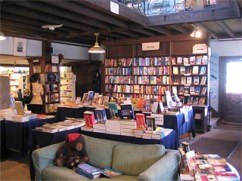
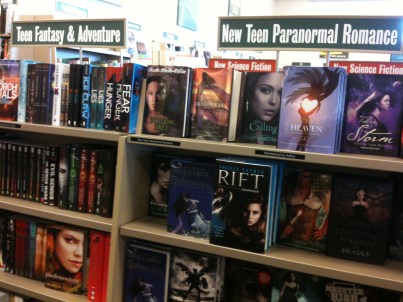
A few weeks ago, while I was running errands, I found myself driving by one of those giant Barnes & Noble Bookstores. Almost of its own will, my car steered itself into the parking lot and then my feet marched themselves into the bookstore, carrying me along for the ride. Okay, I didn’t complain about the unexpected side trip to one of my favorite places on Earth. Bookstores! I have always loved them. However, ever since I began reading books on my Kindle, my visits to real live bookstores have dwindled to far and few between.

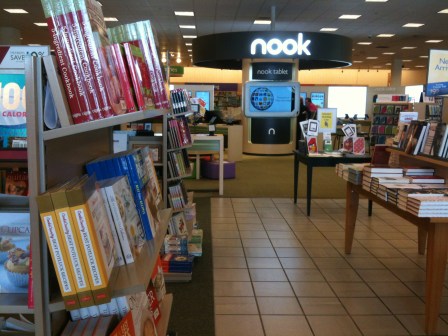
I was looking forward to wandering through the aisles and browsing the shelves without anything specific in mind since it’s the discovery of the unexpected novel that always excites me most when it comes to bookstore adventures. So, when I walked insider, I was completely taken aback by the enormous Nook Center that had taken over the heart of the store. Where a small information desk had once stood, an enormous Nook sign now rose, towering above the stacks and beaming its fluorescent light across the shelves of paper books. NOOK. NOOK. NOOK.

The once modest and humble Nook stand, which had been part of the information desk, had evolved into a media monster. Barnes & Noble now had its own Mount Doom with the NOOK sign beaming down at me like the Eye of Sauron, following me no matter where I went in the store. NOOK. NOOK. NOOK.

Through the aisles and along the shelves there was always a clear line of sight to B&N’s unblinking electronic eye.

NOOK. NOOK. NOOK. The word blasted its message into my brain even as I forced myself to focus on the paper. Look at those lovely covers! Solid books to hold in your hands, to get signed by your favorite authors, and to place like trophies upon your personal bookshelves. Still, no matter how beautiful and exciting the covers were, my eyes were constantly drawn to Barnes & Noble’s version of Mount Doom: The Nook Center.

I grabbed a copy of Nancy Holder’s new book ON FIRE: A TEEN WOLF NOVEL and held it to my chest like a shield as I hurried to the register, scurrying through the store, trying not to make eye contact with the Nook. I had to get out of the store without picking up a NOOK. NOOK. NOOK. After all, what would my Kindle say if I brought home another eReader? That’s a conversation I’m not ready to have until my Kindle shows some sign of aging, breaking, dying, or needing an update. After four years, it still works like a champ. Plus, it has about a hundred books on it.
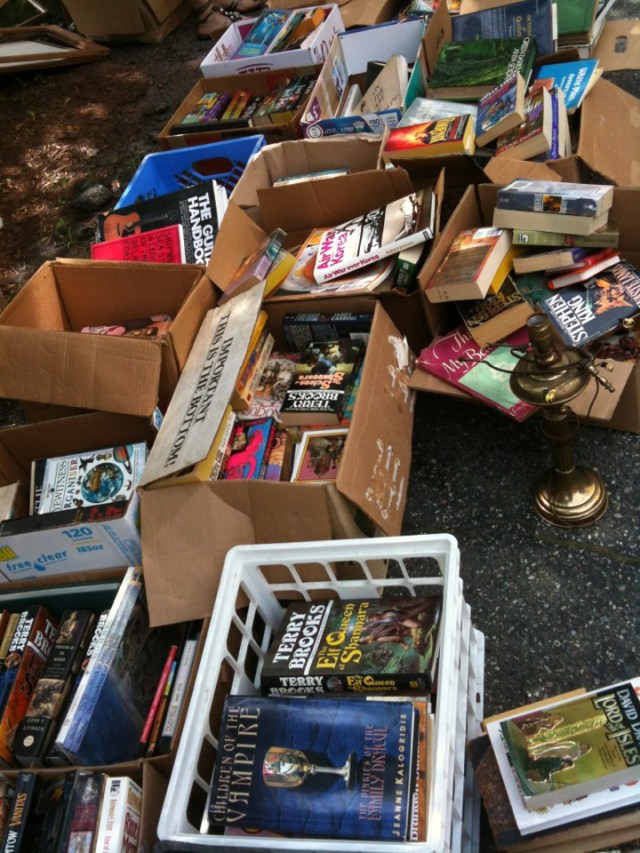
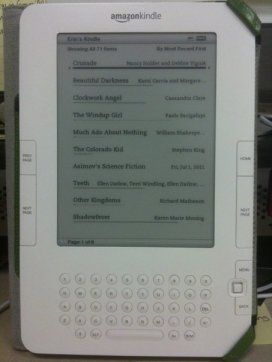
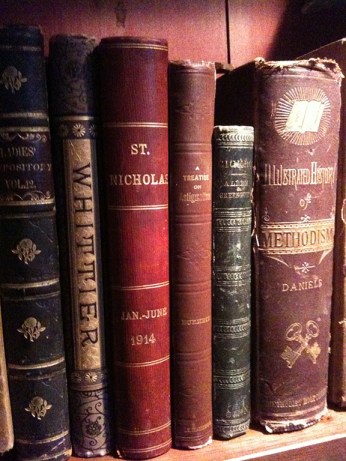
On my way home from Barnes & Noble, I stopped at a yard sale that had shiny beautiful objects spread out across a man’s lawn and up his driveway toward the garage. It was the shiny object that made me stop, but it was the sea of science fiction and fantasy books that held me there for nearly an hour as I sorted through what I can only call the most amazing library of books that I have seen in years. Bradbury. Asimov. Brooks. Tolkien. Martin. Pohl. Heinlein. Wells. Herbert. Jordan. Gibson. King. The names go on and on and on as did the boxes!

The thing is, I had just escaped the NOOK and I had just finished singing the praises of my Kindle. In stark contrast I was now wandering around boxes upon boxes of paper book, pulling out treasures of the past, and for a moment I stepped back to take a picture of my amazing discovery and the thought hit me that I was sifting through a paper graveyard. I was searching through books that had once been a man’s prized collection, but were now abandoned to the masses for the meager prices of $0.25 for paperbacks and hardbacks for a $1.00. The books were piles in stacks and crammed into boxes like headstones that were too weary of standing upon their shelves, and I felt a terrible sadness as I realized I had many of these books on my Kindle.

I walked among a paper graveyard remembering the first time that I read The Sword of Shannara, and here it is was–a first edition. Seeing that Terry Brooks novel brought back fond memories from my teenage years of me lying down on our living room carpet and reading the first of many new Shannara books to come while listening to this cool new band named U2. The sense memory from that experience was so strong that I felt like a child again as I held the yard sale book in my hand. It was an experience that I never felt with any book that I have read on my Kindle.

Books are going digital. People are shopping online. Reading is now done on a tablet. People want extra space in their houses so they replace the paper with electronic files (that are not nearly as permanent at they may seem) and in come the NOOKs, Kindles, and digital downloads. How can we possibly stand against a future where books can be purchased and read with a click of a button and where we can store entire libraries within a thin object no larger than a paperback?

The idea of having a worldwide library literally at our fingertips is an exciting and thrilling prospect. The question is what will be lost if the paper is removed from the reading experience? How does turning a paper page affect your experience of reading a story and how does seeing the spines of your favorite books liked up like proud soldiers upon your shelves make you feel? Electronic books once purchased are little more than digital links with no physical representation of the story that you just experienced. Ebooks lack the heft and power that come with holding 300 pages of bound paper in your hand and can’t possibly compete with the beauty of book spines placed upon your shelf. How far will the digital revolution go? How many more paper graveyards will be spread out across our lawns and driveways with each paper tombstone being sold $0.25 for a paperback and $1.00 for hardcover. How many books will be dumped into recycling bins and landfills? What will we lose in the process of going digital?

Then again, what will be gained? More importantly, how will the value of paper books change over time for readers, writers, and publishers?

I look at my bookshelves in my house, and the sadness of seeing the paper book industry contract changes to something else. In the past, our books were bound with engraved leather and decorated with gold lettering. When the industry changed to hardcovers with dust jackets and pulpy paperbacks, we retained our love and appreciation for the books that came before even as people bemoaned the loss of the beautifully bound books. However, those books have never quite left us. In fact, I don’t think they ever will.

Old books are kept as collectables while new books continue to be printed for those of us who love to hold a good book in our hands. Our books may be growing more and more digital by the day, however, Mount Doom and the NOOK. NOOK. NOOK. can never replace the reading experience or the beauty of our paper treasures placed lovingly upon our shelves. Some books might end up in paper graveyards, but I believe that paper books will always remain a vital and valued part of the reading experience–even if we do most of our reading on tablets, Kindles, and NOOKs in the future.

Posted in Books and Literature, Uncategorized | 4 Comments

Review: Robot Series by Isaac Asimov

The following is a guest post by Sci-Fi Bloggers. Sci-Fi Bloggers is an online magazine covering all things science fiction and fantasy: movies, TV, books, video games, comics and more.

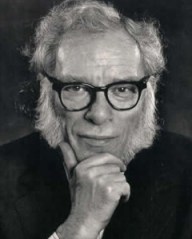
I’m not exaggerating when I say that Isaac Asimov was one of the greatest and most influential science fiction writers of all time. He gave us a lot of great stories and ideas. The Robot Seriesis one such story.

Isaac Asimov

The Robot Series takes place in Earth’s distant future where most of humanity lives in gigantic megacities where the outside world is rarely glimpsed. It’s so bad that most humans suffer from agoraphobia and basically shut down mentally when exposed to places outside of the city. Humanity has split into two groups: Spacers who are descendants of settlers of other worlds and humans who remain on Earth. Spacers have access to more advanced technology and are more liberal in their use of robots, which are still shunned on Earth.

The books follow Earth detective Elijah Bailey and his partner R.E. Daneel. The hitch is that Daneel is a robot, hence R.E. Daneel is your basic android, he looks like a human. Think buddy cop movie where the two don’t initially get along. Over the course of the series, the two actually grow very close and become for the lack of a better term, friends. It’s a heartwarming part of the story when you see these two actually get along.

The Robots of Dawn

Trust me, he needs a good rest after the day he’s had. What with stopping a war and all.

The stories are not your run of the mill science fiction. Think of hard-boiled detective fiction, but with robots and space crafts. Basically each book in the series, well the first three anyway, is a murder mystery that these two characters solve. Added to these stories is some really good science fiction. For example, the agoraphobia of the Terrans who live in dome covered mega-cities or the fact that most of the food on Earth is artificially made. The Three Laws of Robotics are in full effect in the series and play a large role in the mysteries. The mysteries themselves are very entertaining and well done. Not only are these great science fiction books, but really good detective stories as well.

Overall this series is fantastic. The characters are rich and engaging and the stories intriguing and entertaining. I loved reading these books when I was younger and I recommend them to anyone whether they love detective stories or good old fashioned science fiction. These are some of the best works in the genre to date and I can’t recommend them enough. There’s no low point in any of the books. It’s Isaac Asimov, were you expecting anything less?

~
Check out a young Isaac Asimov discussing The Three Laws of Robotics!

Posted in Books and Literature, Reviews, Science Fiction, Uncategorized | 5 Comments

New Writer Spotlight: The Ajnir by M.P. Gunderson

I recently came across M.P. “Matt” Gunderson’s new science fiction novel The Ajnir, which is scheduled to be released in August 2012 by Turning Stone Press. Although I haven’t had a chance to read the book yet, I thought it looked interesting and  was curious about what inspired the story. So, I asked, and Matt responded with the following answer:

M. P. Gunderson:

The first inspiration for the book came to me in 2002, when I was having a glass of whiskey in front of a movie (I can’t recall the movie actually, but I don’t think it had any relation to what I was imagining for the book). I was thinking of a guru from India I had been reading about by the name of Satya Sai Baba, when this idea formed in my head about a planet that had split in half thousands of years ago. That’s not to say the book arises out of some sort of divine revelation. But I happen to be a firm believer in Blake’s view that creative art is not invented but rather received, perhaps from another reality other than our own.

The book draws its substantive roots from the the esoteric wisdom of the east, including astrology — mainly the idea that higher beings or gods or goddesses inhabit a planet — and the concept (or lack of concept, you might say) of a Bodhisattva. But the style of the book is almost purely Western fantasy and science fiction. I was reading David Lindsay’s A Voyage to Arcturus when I wrote the last half of the book, a very strange, haunting esoteric masterpiece, which influenced some of the later parts of the book, though not entirely. Philip Pullman was another major influence, though I don’t really think the book in its entirety is remotely like either novel.

Thematically, I wanted to explore the idea of how societal divisions emanate sometimes from limited idealogies about one’s being and self. High class, low class, Islamic or Christian — these are idealogies which often separate and divide rather than connect. I’m not saying that these cultural concepts for one’s self have to be rejected. They just have to be undergirded by an awareness of awareness. I think of it from a Hindu or Buddhist perspective. You might have been a black person or a woman in your last life. In this life, you may be a white person or a male. So the cards of one’s identity are always shuffling in the cosmic deck. Your identity keeps shifting over many lives, though your awareness, some essential aspect of you, remains unchanged. Some people may not buy into reincarnation, but it’s nevertheless an interesting way to look at cultural identity and what it means.

Yep. Sounds interesting to me. Here’s the official book blurb:

The Ajnir: means secret worker in the language of Ganir; one who has been “awakened” and is directly in contact with the Inkiri, a higher dimension of reality. In The Ajnir, Gunderson introduces us to a civilization trying to unravel a mystery that could help them heal from a rift that took place thousands of years ago. Urshan Dai is a resourcestarved planet in another galaxy that inexplicably split in half millennia ago. Following the baffling riddles of a strange apparition known as a uriel, Nadan and his friends, Naria and Ranum, journey across Urshan Dai, on a quest to uncover the mystery behind the other half of their planet’s disappearance. With a cast of characters as fully realized as those in many beloved science fiction novels, Gunderson takes us on an interdimensional travel adventure, many galaxies away. Blending science fiction and fantasy, his novel explores themes of magic and metaphysics, and the divisiveness inherent in society. The Ajnir is the first book in a trilogy.

Posted in Books and Literature, Interviews, Uncategorized | 1 Comment

Independent Bookstores Interview

Over the last few years, the book industry has seen a great deal of change both in the production of books as well as in the retail sales of books. Amazon and other big chain retailers have taken to the Internet to peddle their wares while brick and mortar bookstores like Borders Books have been forced to close their doors. Through the trials and tribulations that come with an evolving book industry many intrepid independent bookstores continue to succeed and even grow. Two such independents are Mysterious Galaxy and the HugoBookstores.

Mysterious Galaxy is a specialty bookstore owned and operated by Maryelizabeth Hart, Jeff Mariotte and Terry Gilman. They opened their first story in San Diego, California in 1993 and now have a second location in Redondo Beach. “In the store’s 18-year history selling works of science fiction, fantasy, mystery, suspense, and horror, the team at Mysterious Galaxy has built a community of fans that extends beyond the borders of San Diego County, beyond the borders of independent business, and beyond the borders of their specialty genres.” —Mysterious Galaxy History

HugoBookstores offer a wide selection of books, both fiction and nonfiction, and are owned by Robert Hugo and John Hugo who has recently celebrated over 45 years of selling books. His original store The Spirit of ’76 Bookstore and Card Shop was located in Marblehead, MA. Eventually, Bob moved “his store to a 3,000 square foot space in a more prosperous part of town. He purchased the building in 1976, knowing that if his business were to grow, he needed to expand. This he did by acquiring a second store in 1988 — the Book Rack in Newburyport and the Andover bookstore in Andover, Mass. in 1992. The Andover store is the second oldest continually operating bookstore in America. Founded in 1809.” —HugoBookstores History

In order to get a better understanding of life as an independent bookseller, Underwords interviewed both Maryelizabeth Hart from Mysterious Galaxy and John Hugo from HugoBookstores to hear about the book industry from an “independent” point of view. We offer special thanks to both of our booksellers for making the time to participate in this interview with Underwords.

~

HugoBookstores: Spirit of ’76 in Marblehead, MA

For people who haven’t yet discovered your store, how would you describe it?

HugoBookstores: Quirky, each [store] is very different from the others. Across the board, though, we have great book loving staff members who enjoy finding just the right book or gift for you.

Mysterious Galaxy: Mysterious Galaxy offers books of Martians, Murder, Magic and Mayhem (with occasional Masks, Matchmaking, and Munchkins). We are a specialty genre store in Southern California’s Redondo Beach and San Diego, with a focus on SF, Fantasy, Mystery, Suspense, and Horror.

In a world where the big brick and mortar stores like Borders Books seem to be crumbling, what role do you see emerging for independent booksellers? How might that role evolve in the future?

HugoBookstores: Andover Bookstore in Andover, MA

HugoBookstores: There will always be a place for physical bookstores and with the collapse of Borders this opens up sales for independents again for the folks who still want to browse touch and feel real books, gifts and cards. For us, we opened our 4th location in a closed Borders location last November–if Barnes and Nobles closes there will continue to be a rebirth of local indie bookstores!

Mysterious Galaxy: Maybe it’s from being a genre bookseller so long and living through the repeated declarations of the death of various genres and / or sub-genres, but while the loss of Borders was not good for anyone in publishing, from authors to publishers to other booksellers to readers, I don’t think its closing is necessarily a referendum on the vitality of brick and mortar stores, indies or chains. I think the key to succeeding is providing community, whether that’s in the form of hosting events, working with local schools and libraries, supporting authors at off-site events, or other interactions with readers.

What inspired you to open a bookstore? What do you love most about your job, about owning a bookstore?

HugoBookstores: Collage

HugoBookstores: I grew up in the business, ringing sales as young as 7 years old in my Father’s first store in Marblehead. I’m a people person so I love working with great booksellers and talking books with the myriad of different folks who come into our stores to shop and talk books, life, local politics, etc.

Mysterious Galaxy Bookstore in San Diego, CA

Mysterious Galaxy: When Mysterious Galaxy opened our San Diego location in 1993, it was (and continues to be) a labor of love and a reflection of the books we are passionate about. Co-owners Jeff Mariotte and Terry Gilman and I believed that the fans in Southern California would welcome a store specializing in speculative fiction and mystery and suspense, the genres we love, and the community response bore that belief out.

What I love most about being a bookseller is sharing the books I read and am enthused about with other readers – and also learning about new-to-me books from them!

What are some of the biggest challenges you face as an independent bookseller? How have you resolved or faced those challenges?

HugoBookstores: The Book Rack Bookstore in Newburyport, MA

HugoBookstores: Amazon and eBooks are the two biggest obstacles because of the deep discounts and ease of purchase ability, not to mention the loophole that allows them to avoid sales tax. That said, the ABA recently inked a deal with Kobo, and I think once we have an eReader device to sell we will get into this market with some success. We have also added a great deal of gifts and sidelines to each of the stores to replace the 10-15 percent loss in hardcover sales that shifted to eBooks; gift purchases are all about serendipity and the margins are better than books so, in the end, we are holding our own just fine. Also, people in good communities still know and understand that if they don’t shop locally they won’t have the small independent stores and bookstores – so even if they do shop Amazon sometimes they still remember to give us a portion of their dollars so we can stay on Main Street.

Mysterious Galaxy Authors Event

Mysterious Galaxy: As independent booksellers we have faced a number of challenges, from deep discounting to consolidation of publishers (something that affected publishing as a whole) to finding ways to effectively offer our customers who want to purchase electronic books from us the best options. We are pleased to be in an environment where I think the average person is more aware of the benefits to buying locally and/or independent, and we are also very appreciative of the efforts of the American Bookseller Association to work very hard on behalf of its members on some of the big picture issues. One example of the latter is the upcoming partnership between Indiebound stores like Mysterious Galaxy and the Kobo ebooks program, including readers.

What can customers and readers expect from a shop like Mysterious Galaxy or HugoBookstores that an online reseller like Amazon.com or a big conglomerate retailer can’t offer?

HugoBookstores: Real people, talking real books, who love the product they sell. People who aren’t in it for huge corporate retail greed and have something you just might love that you never heard about before walking in the door.

Mysterious Galaxy: Charlaine Harris (author) & Maryelizabeth Hart (MG owner)

Mysterious Galaxy: I think the two key elements that distinguish us are curation and connections. By focusing on the books and genres we are enthused about, we have a far broader personal knowledge of our inventory.

This is all generalizations, by the way, as nearly every chain bookstore has passionate booksellers in it; but the distinction holds for Amazon and other retailers to whom books are a loss-leader to entice customers to purchase more profitable items.

.

How long have you been in business? What would you say is your secret to success?

HugoBookstores: I began in 1965; I would say the secret is consistently changing with the times and continuing to offer great service and personal independence. Being blessed with great staff booksellers who passionately care about the business doesn’t hurt either!

Mysterious Galaxy: Terry Gilman (owner), Denise Hamilton (author), & Maryelizabeth Hart (owner)

Mysterious Galaxy: Mysterious Galaxy opened in San Diego in 1993, as mentioned, so we are a few months away from our 20th anniversary. Our Redondo Beach location opened in September 2011, so has just finished its first year in business.

I don’t know what our secrets to success might be, but I do want to credit my partner, Terry Gilman, in particular for helping us make sure that we pay attention to the business of Mysterious Galaxy, and also for always being willing to try different programs and ideas, often in partnership with publishers or community organizations.

~

Again, special thanks to both Mysterious Galaxy and HugoBookstores for participating in our independent bookstores interview. Here is a quick list of their locations. If you’re in the area, be sure to stop in and check out their shelves. Supporting your local bookstore is a vital part of sustaining your local economy and keeping the book industry healthy and strong. Go forth and read!

Mysterious Galaxy Bookstores

Mysterious Galaxy San Diego
7051 Clairemont Mesa Blvd., Suite #302
San Diego, CA 92111
Tel: 858-268-4747

Mysterious Galaxy Redondo Beach
2810 Artesia Boulevard
Redondo Beach, CA 90278
Tel: 310-542-6000

HugoBookstores

The Spirit of ’76 Bookstore and Card Shop
107 Pleasant Street
Marblehead, MA 01945
Tel: 781-631-7199

The Spirit of ’76-2
450 Paradise Road
Swampscott, MA 01907
Tel: 781-581-7676

Andover Bookstore: More than a Bookstore
89R Main Street
Andover, Massachusetts
Tel: 978-475-0143

The Book Rack Bookstore
52 State Street
Newburyport, MA 01950
Tel: 978-462-8615

Posted in Books and Literature, Interviews, Uncategorized | Tagged , , , , | Leave a comment