We’ve been in London for a couple of days. It’s incredible how much there is to do in this city. Even if you stuck with all of the standard tourist fare, you would be hard pressed to do everything on your list within 10 days. If you’re like us and you’re trying to get off the beaten path, you’re facing quite a challenge. However, it’s one we’re ready to take on!
For classical music lovers, St. Martin in the Fields in Trafalgar Square is a must. Of all the times we’ve been here, we’ve never ventured down into the Crypt. However, after a long day of wandering the streets of London, we were ready for a break and the Crypt Cafe seemed like the perfect reprieve. The Cafe itself is much larger than I expected and sitting down in the brick cavern was an interesting experience, especially with the marker stones on the ground memorializing those who are now long gone. It’s a wonderful place that exudes its own special type of history.
In addition to the Cafe, there is quite a bit of space for people to wander around, to sit and relax, to sightsee, and to purchase trinkets in the gift shop. While there, Tom and I did a little investigating of our own.
Here’s a picture of the inside of the Crypt area, which is just beyond the Cafe. Look at the sloping pilars and brickwork. The entire Cafe as well as the rest of the space looks like this. Even though there are quite a few people down here, there is a stillness to the experience that you can only get below ground, surrounded by brick, stone and earth.
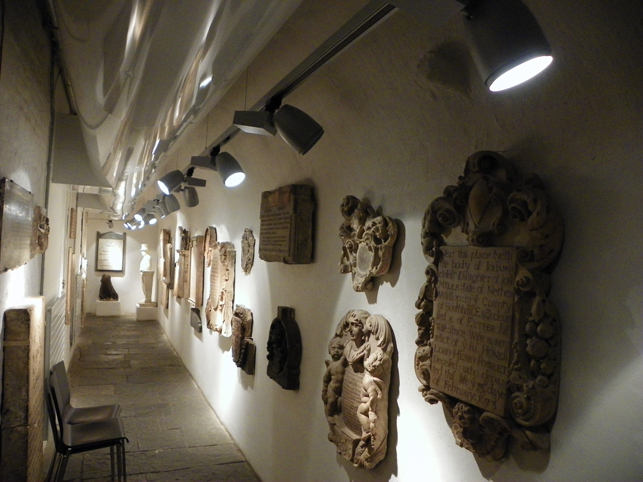
At the end of this section of the Crypt is a longish L-shaped hallway with memorial plaques and figures, which are amazing. A hidden gem that most people probably don’t discover when visiting the Cafe. We were down here for a good twenty minutes reading each plaque and only saw one other person.
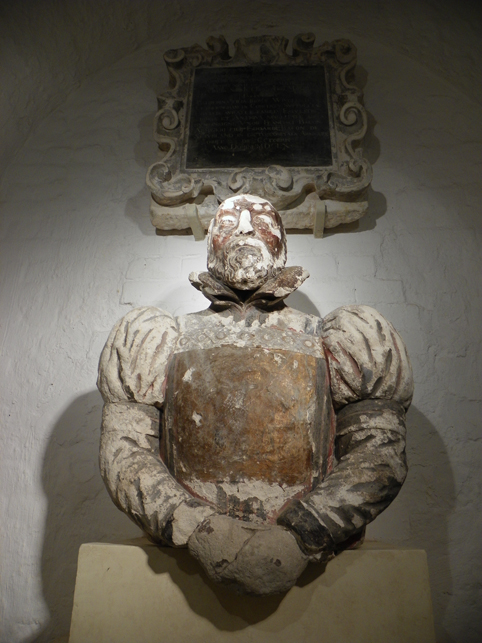
The carved stones are absolutely gorgeous. About halfway down the corridor is this charming gentleman.
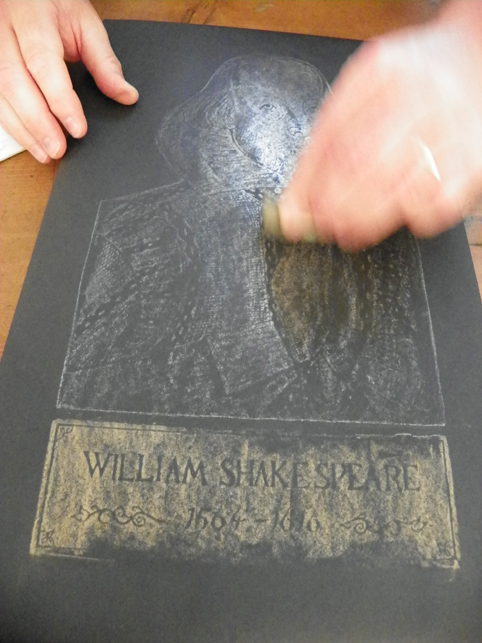
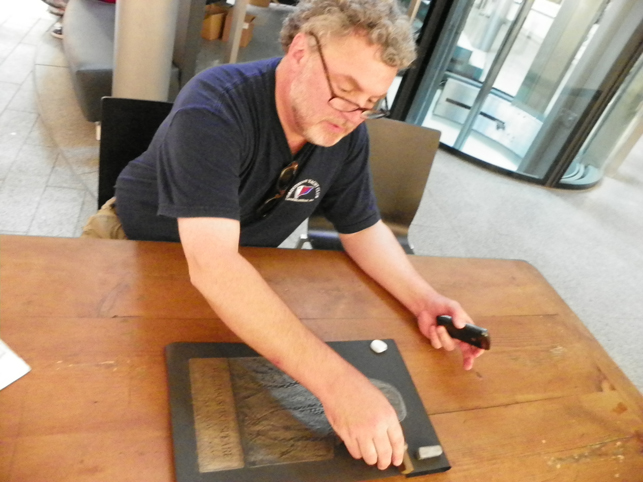
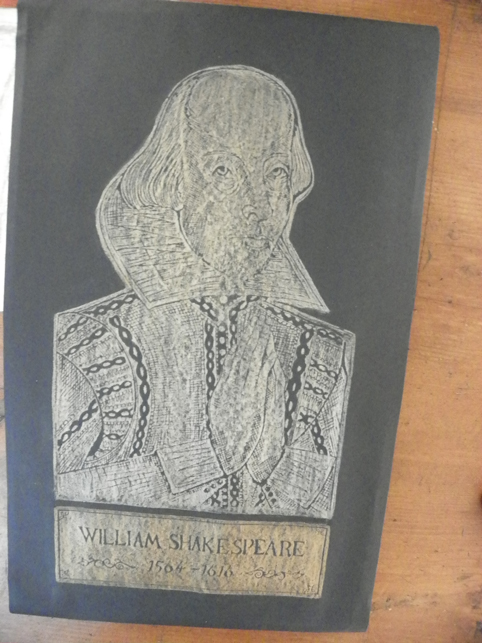
We then moved onto the shop where we purchased a few things to take home, and we did a brass rubbing of Mr. William Shakespeare. What a great memento of our trip. Plus, it was a blast to work on this together. It’ll be something that we can hang on our wall and remember our visit to the Crypt Cafe.
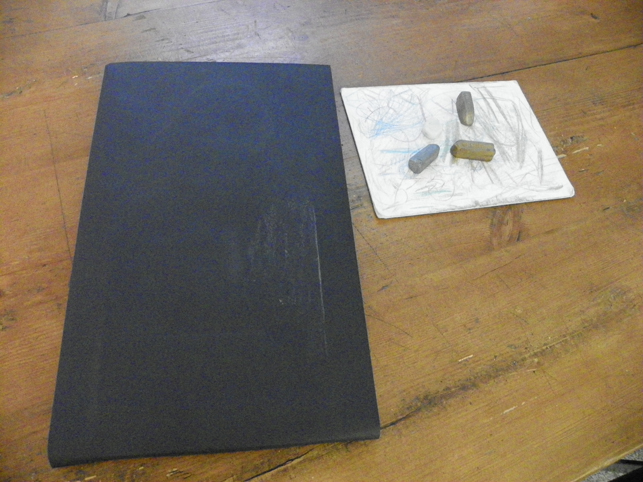
Once you pick out the figure, bring it to the desk and they’ll set you up with black paper and directions. Here’s the long and short of it.
First, you tape your black paper to the brass plaque, lightly pressing down around the edges so that you know where the image ends. Then take your color stick and very lightly go over the image so that you can see the faint shape of the figure.
Once you can see the faint shape of the image, then you go over it with a bit more gusto. Press hard with your color stick, rubbing in one direction only. Pick a direction and stick with it. Don’t go in circles, back and forth, or multi-directional. For some reason, the detail is much clearer when rubbing in one direction.
See your rubbing take shape right before your eyes! Keep working. The more elbow grease you use, the better it will look. Here’s Tom working on some of the finer details.
Pretty soon you will end up with an awesome looking brass rubbing to take home. They have dozens of interesting historical characters and images to choose from. And here is the big “reveal” of our brass rubbing.
Voila! Shakespeare in the rub.
And that is your literary art moment for the day from Crypt Keeper Underwood.
After an incredibly pleasant flight on Delta airlines (in coach no less), we have arrived safely in London! Over the next week or so, I’ll be making a variety of posts that feature Underwords’ adventures in London – adventures which will feature literature, art, plays, sightseeing, and more!
Please note that the Underwords in London posts are dependent upon the weak internet signal that I get here, but we’ll do the best we can. In the meantime, here is the view from our hotel window. I have to say, it’s one of the best views of the London Eye that I have ever seen.
DAY:
NIGHT:
Check out that full moon!
Next: Brass rubbings in the crypt beneath St. Martins in the Field.
Kingkiller Chronicles reviewed by Heather Magaw. See below for special giveaway.
Title: The Name of the Wind (Kingkiller Chronicles, Day 1) Author: Patrick Rothfuss Publisher: DAW Trade Print Ed: Reprint edition – April 7, 2009 ISBN-13: 978-0756405892 Details: 672 Pages | Paperback | $17.00
.
~
Title: The Wise Man’s Fear (Kingkiller Chronicles, Day 2) Author: Patrick Rothfuss Publisher: DAW Trade Print Ed: March 1, 2011 ISBN-13: 978-0756404734 Details: 1,008 Pages | Hardcover | $29.95
~
You may have heard of Patrick Rothfuss’s novels, The Name of the Wind and The Wise Man’s Fear. You may have read other reviews of the books, or at least the synopsis from amazon.com. Both books sound really interesting, but, if you’re like me, you are also completely daunted by the enormous number of fantasy titles out there. They all sound interesting, but the promise of the jacket copy is no indication of the quality within (it’s a crapshoot). Like me, you have thoroughly examined the fantastic hero’s journey, and you’re poor. So, you talk to your friends, at exhaustive length, about what they’re reading, and you buy the books they recommend. Well, my friend, here is your recommendation: you must read The Name of the Wind and The Wise Man’s Fear.
If you haven’t heard ofRothfuss’s novels, The Name of the Wind begins in a small inn in a tiny town on the outskirts of the empire. The owner of the inn, Kote, seems to be an ordinary man; the townspeople are ordinary people, the village is an ordinary village. The story escalates from there: outliers of the empire’s distant war start showing up in town, and it turns out that Kote is actually Kvothe, legendary musician/storyteller/arcanist/swordsman and, lately, villain with a price on his head. He has retreated to this village to escape his past and the charges against him. Of course, no one can hide from his past, and Kvothe’s soon catches up to him, in the form of Chronicler, an equally renowned storyteller, who has tracked Kvothe to his remote village in order to obtain a first-hand account of his life. Thus begins three days (The Name of the Wind and The Wise Man’s Fear each cover one day, with the third yet to be published) during which Kvothe tells his version of his legendary life, interspersed with “reality breaks” for things like sleep, meals, the conducting of business (both novels actually take place in a tavern, after all) and dealing with the aforementioned outliers.
The books are a fantastic, straight-up adventure story, with magic, a number of supernatural bad guys, a resourceful, engaging hero and an interesting mix of secondary characters, in a setting that enhances the story with its solidness. The stories also function as restrained meta-fiction: finely-crafted novels about a master storyteller giving his life’s story to an equally illustrious colleague. Rothfuss engages both the intellect and the gut; you can cheer for Kvothe and laugh or cry at his exploits, and at the same time question his, and everyone else’s, motives, the nature of truth, and how much of a person’s circumstances is of their own making.
The biggest thing, though, that distinguishes The Name of the Wind and The Wise Man’s Fear from other post-modern or fantasy or post-modern-fantasy novels is its finely-crafted restraint. Rothfuss shows amazing self-control in his worldbuilding, avoiding the panoramic descriptiveness that pushes the settings of so many fantasy novels to the forefront, overshadowing the plot and characters. The magic and other fantastic aspects are treated as natural parts of an ordinary world- the characters are no more amazed by them than we are amazed by the internal combustion engine or the internet. Though there are remarkable events scattered throughout the stories, their rarity makes them all the more remarkable. The characters are complex and fully developed, but by no means transparent; their motives are hidden or questionable, they are by turns magnanimous and self-involved, and endearingly fallible. I was particularly pleased with the female characters, who are as capable and fully realized as the men, a rare treat in a fantasy novel. In fact, all the characters could easily function in any modern novel; they would not seem out of place in a Starbucks or on a newspaper staff, though they seem too honorable for a Beltway thriller or a legal procedural.
So again, I truly recommend that you read The Name of the Wind and The Wise Man’s Fear. I guarantee that you will be riveted by the swashbuckling adventure and realistic, lovable characters. You will get hooked by the intimate storyline that does not require reference material to keep track of. A warning before you begin, though: make sure you have a block of free time ahead of you, and are adequately provisioned. Send your children to their grandparents, free your significant other to do as they like. Once you begin reading, you won’t be able to stop until the end.
Enter the KINGKILLER CHRONICLES Contest
Patrick Rothfuss has generously contributed signed hardbacks of the first two novels in his Kingkiller Chronicles. All you have to do for your chance to win the signed copies of The Name of the Wind and The Wise Man’s Fear is to post a note in the comments below by midnight on August 4th. One entry per person.
**However, you can get a double entry by posting a link to review/this contest on your blog, Facebook page, in Twitter, or somewhere else. After you post the URL, let me know in the comments below that you “boosted the signal” and your one entry counts as two entries – doubling your chances to win.**
The contest is open to anyone with a U.S. or Canadian mailing address. The winner will be chosen at random and contacted via email for shipping instructions. If you are under 14, please get your parent’s permission to enter this contest.
~
Special thanks to Heather Magaw who wrote this review for the first two novels in the Kingkiller Chronicles. When the opportunity arose to do this review and to host this special giveaway for Patrick Rothfuss, I asked the person whose verbal review of these books convinced me to read them, and that person is Heather.
Thank you to everyone who entered. If you haven’t yet read these books, consider them a “must read.”
Stay tuned for more exciting giveaways. We have two signed copies of Ghost Story by Jim Butcher that will be making their debut in the next week or so.
Harry Dresden Is Dead and Kickin’
by Erin Underwood
July 26, 2011
CHICAGO – Harry Dresden, Chicago’s resident wizard-for-hire, has been reported missing and is suspected dead. Dresden was last seen on his brother’s boat before going missing. The only evidence of foul play was a bullet hole and some blood, but not enough to verify if the shot was fatal. Dresden’s body was not found on the boat and police suspect he fell overboard as a result of the shooting.
Six months after his death, a source only known as “Bob” has placed Harry Dresden’s ghost as being in the company of the local ectomancer, Mortimer Lindquist, and several other shady characters of questionable natures. Another source claiming to be close to the late wizard verified that his spirit had unfinished business, which required him to track down his killer in order to save the people closest to him before moving on to his next phase of existence. However, Dresden’s investigation is rumored to be complicated by the appearance of a powerful and dangerous force in the spiritual realm that threatens to either wipe him from existence or force him into becoming a mindless wraith destined to haunt the highways and byways of Chicago’s afterlife.
With only a few days to complete his mission, eye witnesses verify that Dresden’s activities are as fast paced and as exciting as ever. Stakes are high as Dresden is forced to come to terms with his new ghostly limitations and abilities. While some sources may claim that Dresden spends a significant amount of time strolling down memory lane, others insist that his extreme memory moments are packed with a powerful punch.
Reports place several of Dresden’s friends at key locations where deadly skirmishes took place both in Chicago as well as in the Nevernever. While Dresden’s ghostly return to Chicago was triggered by the need to find his killer, witnesses have confirmed that his purpose became conflicted after being confronted by the repercussions that his friends have suffered as a direct result of his past decisions associated with saving his daughter from the Red Court. His personal mission is soon at odds with saving his friends, and in true Dresden style Harry’s ghost finds his own special way of reaching the next phase of existence. Come what may.
Harry Dresden’s “Ghost Story,” as jotted down on the back of a bar napkin by writer Jim Butcher over a pint at McNally’s Pub, is a compelling tale of one wizard’s struggle to come to terms with his death after life experiences. Our unconfirmed source, “Bob” claims that Jim Butcher’s magnificent transcript of Dresden’s experiences has truly brought the wizard’s story to (after)life. Readers will heartily enjoy making a meal of Dresden’s Ghost Story as they devour his newest set of experiences and memories, which pack their own special punch.
Off the record, former detective Karrin Murphy confirms that Butcher’s Ghost Story is a must read for people who love a shady tales of magic, friendship, and a wise-cracking wizard who refuses to let death get in the way of living his life and doing the right thing.
~
*Please note that this is NOT a real article. If there were actual sightings of magic, mayhem, and wizardly things, you would be the first to know about it from our Eyes on the ground team member based in Chicago.
Title: Ghost Story (Dresden Files, No. 13) Author: Jim Butcher Publisher: Roc Hardcover (July 26, 2011) Print Ed: July 2011 ISBN-13: 978-0451463791 Details: 496 Pages | Hardcover | $27.95
~
A message from the reviewer: If I used a star rating, I would run out of stars for Ghost Story. Yes, I love it that much! Now, stop reading this and go get the book!
Author: Trent Zelazny
Publisher: Black Curtain Press
Print Ed: June 2011
ISBN-13: 978-1617203909
Details: 76 Pages | Paperback | $6.99
~
Publisher’s Blurb: Was she an angel from above, or a walking time bomb of doom?
His life having crumbled, Blake Gladstone returns to his hometown of Santa Fe, and tries to settle back into the unsatisfying life he’d had before he left for Florida.
When he meets Denise, a pretty young blonde with a bag full of tricks, his sad routine breaks, and the more they get to know each other, the more Blake can’t figure out if he’s on a road to salvation, or a road back to hell.
Note: I purchased this book to review.
~
Fractal Despondency by Trent Zelazny is dark and gritty novella, filled with an honesty of experience that will leave you feeling as if you just walked a mile in Blake Gladstone’s shoes. From Blake’s first appearance on the page, the grimness of his situation is made painfully clear. Newly returned home to Sante Fe from Florida, he bears the physical and emotional wounds that have bled away every ounce of joy and love that had once lived inside of him. However, when Denise comes into his life, a beautiful blond radiating excitement and trouble, Blake finally feels something. Only he doesn’t know if that’s a good or bad thing.
Zelazny has deftly captured the desperation of emotion that a person feels when confronted with and forced to deal with the loss of a loved one. Secrets, lies, mistakes – all these things bubble to the surface as Blake’s past and present collide in the “now” that he is experiencing as a result of his encounter with Denise.
From the writing to the characters to the plot of the story, Zelazny’s prose will reel you in and make you wish that you could do something, anything to help Blake overcome the affects of the trauma he has suffered. You can’t help but to want to assist him, all the while knowing there is nothing you can do except to go along for the ride to see if Blake will be okay in the end. It is clear that he must go through this experience if he is ever going to reclaim anything of his former self, and even then he may not succeed.
Fractal Despondency is a must read novella for anyone with a taste for dark, noir literature. Trent Zelazny is someone you’ll want to follow when his next book comes out.
Award winning editor Ellen Datlow is giving away 5 (YES! FIVE!) signed copies of her new anthology Supernatural Noir.
The copies will be signed by Ellen Datlow and several of the contributing authors including Gregory Frost, Jeffrey Ford, John Langan, Rick Bowes, and Paul Tremblay as part of the special reading they are doing on July 22nd.
For those of you in the New York City area, Ellen is hosting a special reading for Supernatural Noir on Friday, July 22nd at the KGB Bar, starting at 7:00 pm located at 85 E 4th Street (off 2nd Ave., upstairs), New York, NY.
If you’re in New York City, I highly recommend attending this very special reading, which is not a part of the normal Fantastic Fiction series that is held there every month. The Supernatural Noir readers will include Ellen Datlow (as host), Gregory Frost, Jeffrey Ford, John Langan, Rick Bowes, and Paul Tremblay. I’ve heard most of these authors read before, and they are terrific.
If I weren’t running this contest on Underwords, I’d be the first entry on the list since I have been waiting for this book to come out for months. Yes, I will be buying a copy for myself, but I digress! We have 5 signed copies of Supernatural Noir up for grabs, which means that you have an excellent chance to win a book.
Enter the SUPERNATURAL NOIR Contest
All you have to do for your chance to win a signed copy of Supernatural Noir is to post a note in the comments below by midnight on July 27th. One entry per person.
**However, you can get a double entry by posting the link for this contest on your blog, Facebook page, in Twitter, or somewhere else. After you post the URL, let me know in the comments below that you “boosted the signal” and your one entry counts as two entries – doubling your chances to win.**
The contest is open to anyone with a U.S. mailing address. The winner will be chosen at random and contacted via email for mailing instructions. If you are under 14, please get your parent’s permission to enter this contest.
A hit man who kills with coincidence . . . A detective caught in a war between two worlds . . . A man whose terrible appetites hide an even darker secret . . .
Dark Horse once again teams up with Hugo and Bram Stoker award-winning editor Ellen Datlow (Lovecraft Unbound) to bring you this masterful marriage of the darkness without and the darkness within. Supernatural Noir is an anthology of original tales of the dark fantastic from twenty modern masters of suspense, including Brian Evenson, Joe R. Lansdale, Caitlin R. Kiernan, Nick Mamatas, Gregory Frost, Jeffrey Ford, and many more.
* For fans of horror, noir, fantasy, crime, and the short fiction format.
* Sixteen stories for just $19.99.
The Table of Contents Includes:
Introduction Ellen Datlow
The Dingus by Gregory Frost
The Getaway by Paul G. Tremblay
Mortal Bait by Richard Bowes
Little Shit by Melanie Tem
Ditch Witch by Lucius Shepard
The Last Triangle by Jeffrey Ford
The Carrion Gods in Their Heaven by Laird Barron
The Romance by Elizabeth Bear
Dead Sister by Joe R. Lansdale
Comfortable in Her Skin by Lee Thomas
But For Scars by Tom Piccirilli
The Blisters on My Heart by Nate Southard
The Absent Eye by Brian Evenson
The Maltese Unicorn by Caitlín R. Kiernan
Dreamer of the Day by Nick Mamatas
In Paris, In the Mouth of Kronos by John Langan
* ~ * ~ * ~ *
Congratulations Supernatural Noir Winners!!!!
Val Lies
Ben O’Connell
Bradzooks
Jenna Gwyn Ryan
Barb Moermond
Ilsa J. Bick, MD, a child psychologist and YA author, recently published an article on the Hunger Mountain site in which she responds to a pair of essays by Meghan Cox Gurdon, Children’s Reviewer for the Wall Street Journal, who calls into question the dark themes and content within today’s young adult fiction that she believes “invites teenagers to wallow in ugliness, barbarity, dysfunction and cruelty.” The general, the overall gist of Gurdon’s argument is that an overwhelming amount of YA fiction is dark and violent, and that adults condone such language and acts by allowing kids to read this material. I can’t help but to think of the dark and violent fables and fairytales that parents used to tell children in the “olden days” to keep them safe, to scare them away from stepping off the path through the forest, or trusting strangers. However, that example strays away from the topic of contemporary literature.
In her essay, Gurdon says, “The larger question is whether books about rape, incest, eating disorders and “cutting” (self-mutilation) help to normalize such behaviors for the vast majority of children who are merely living through the routine ordeals of adolescence.” This is a troubling thought to me since everyone I knew when I was growing up thought I had a normal experience and that I was well adjusted. What they didn’t know is how well I hid myself from them, and I don’t think Gurdon is taking the public and private face of teenagers into account with this statement.
We each grow up living in our own state of hell to some degree. Some people’s experiences are worse than others, and when you really get down to brass tacks, more people than you imagine live pretty painful lives that are punctuated by bright spots of happiness that allow them to get through the dark days. Some of those people are kids who grow up in an openly hellish situation, who are easily labelled as at-risk youths. Then there are other kids, like me, who grew up in private hells.
Sure we were low income, but our lives looked great on the surface. I was a good kid. I was on a sports team, I didn’t get into trouble, I got decent grades, and I was funny. Plus, I had friends. However, that’s what I let people see; brush away the dirt and you’ll see how poverty, alcoholism, rape, sex, borderline eating disorders, abuse, abandonment, bullying, and cutting affected my life. You would never see the girl who dreamed of having the guts to let her knife slide a little deeper. I couldn’t die knowing that my mom, the only person who gave everything to protect me from the cruel world, would realized how badly she had failed in spite of working three jobs to keep food on the table, a roof over our heads, and the electricity turned on. So, I hid all external signs of my hell behind the guise of a normal childhood. No one even noticed when I switched from cutting my skin to cutting the hair at the nape of my neck to keep people from knowing what I was experiencing.
I am a statistic filed in the wrong column because I purposefully put myself there. While in my hell, with no one to guide me or to help me, the only thing that kept me sane was reading. When quizzed about or ranted at for having my nose buried in a book day after day, I couldn’t tell anyone why I preferred my fantasy world to the real one. I couldn’t tell them why I was obsessed with reading fiction about oppressed people who struggled against impossible odds to overcome terrible things. I couldn’t tell them that I was learning how to become a better, stronger, wiser, honorable, and compassionate person by reading about wizards, aliens, and vampires. I couldn’t tell them that these were fantastical metaphors for the horrors that I struggled against in my real life every time I stepped out the door to go to school, to visit the babysitter, or meet new people.
If it weren’t for writers like Lloyd Alexander, Roger Zelazny, Robert Asprin, Piers Anthony, J.R.R. Tolkien, David Eddings, Terry Brooks, Stephen King, and Anne Rice, I might not have made it through my teens. Sometimes, the only thing that kept me from cutting my wrists instead of my hair was that I needed to know what happened in the next book. Sometimes those books even showed me that people could experience far worse than I had endured and still make it through the day. Heck, if Frodo could make it to Mount Freakin Doom, so could I. I learned how to be the hero of my own story.
….many, many children do live in hell. According to a study by the Foundation for Child Development (and as reported by CNN), more than twenty percent of children in the U.S. lived below the poverty line in 2010. That’s one kid out of every five. As documented in this companion study, the number of impoverished American kids hasn’t been this high in twenty years. Over five hundred thousand are homeless—and that number doesn’t begin to take into account impoverished children around the globe or those who struggle to survive in incredibly violent settings under desperate circumstances.
So . . . that’s a lot of kids in hell. We just don’t see them because they’re not our neighbors.
Now, if you do want to know about some kids like that, talk to a very wise librarian I met a few weeks ago at ALA. She works in Anaheim, and the population she serves lives with violence, gangs, drugs, rape, incest . . . you name it. Know what those kids like to read? They devour contemporary novels that accurately depict their reality. And you know why? Because, in those novels, the kids triumph. They find a way out of hell. These books are quite hopeful because the teens in them do succeed where their parents and society have failed. These novels are journeys of growth from and through darkness toward the light.
When I see someone like Gurdon questioning the kind of literature that helped me to stand up against the bullies in my school, I can’t help but to wonder what kind of charmed life she must have lived to never need to know how to kill a vampire. I also find myself cheering for people, such as Ilsa J. Bick, who rise up in defense of dark literature in order to help clear the air and to protect the stories that helped me navigate my way through my own private hell. I am sure there are kids who lead a shiny happy existence and who would be deeply disturbed by reading a book like Harry Potter and the Deathly Hallows, because that’s a pretty dark book, but I also think that it teaches them a little something about the real world so that they have some frame of reference for when they find themselves knocked on their butts for the first time. Now, take a kid who gets knocked on his butt every day. Harry Potter really isn’t going to give that kid much help; he’s going to be looking for stronger literature that better reflects his own experiences.
Maybe part of the reason dark fiction is so popular among young adults is that kids’ lives are much more complicated today than they have ever been in the past. Maybe there are a lot more kids wearing “normal” masks than adults think. And maybe, like me, they will turn out just fine in spite of their questionable association with deadly orcs, decaying zombies, and beautiful vampires.
And, yes, even now, I am afraid to hit the “publish” button on this post, but I didn’t travel to Mount Freakin Doom for nothing.
In Water to Burn, the second Nola O’Grady Novel, Katharine Kerr hits the page with a well written story that takes off from the first word written.
After bringing down a dangerous coven and ending an inter-dimentional drug ring run by agents of Chaos, Nola finds herself in charge of the Agency’s newly established San Francisco office. However, setting up shop comes with its own set of troubles, which range from a lack of furniture to a stream of Chaos spies and the assignment of forbidding Interpol agent Ari Nathan – who also happens to be Nola’s boyfriend. The pressure is on for them to learn how to live and work together. If they don’t, more than just their lives will be at stake when a mysterious element controlling Chaos Master begins using water to kill innocents, deaths that the San Francisco PD can’t explain and have no chance of stopping. Now, the Chaos Master is after Nola and she’ll need to draw upon every resource available to survive.
Water to Burn jumps right into the story, spending only a modest amount of time explaining Kerr’s unique new world and how psychic powers work. While readers of License to Ensorcell will feel right at home, new readers who are starting the series with book two shouldn’t have a problem keeping up with the action since Kerr does a good job of providing the right information at the right time and in the right way to keep readers comfortably following along even with the accronyms. That said, this is a series that deserves to be read from first book to last.
One of the great things about the Nola O’Grady Novels is that you get a mix of political thriller, mystery, urban fantasy, and romance. Even if you’re not inclined toward one of these genres, Water to Burn provides such a nice mixture that you’re likely to label these books according to whatever genre you love best.
As with the first novel, Nola’s family continues to generate the most interesting storylines and keeps you turning page after page because you can’t help but to care about them. However, much of the novel focuses on the hunt for the Chaos Master and tracking down some dangerous characters who are aiming to harm others. The good news is that the primary storylines that are focused on Nola’s work with the Agency seem to be mingling and merging with her family’s storylines – an exellent sign for things to come.
Nola’s relationship with Ari continues to develop. In Water to Burn, their relationship feels much more real and solid than in the first novel. However, that is largely due to the fact that readers get to know their characters on a much more intimate level in this book. This deepening of their characters has the effect of establishing a believable pace for their relationship’s development as interest and passion deepen to love, binding them together and giving them a reason to risk their own safety to protect each other.
All in all, Water to Burn is an excellent addition to the Nola O’Grady Novels. I would recommend it to readers who enjoy a thoughtful reading experience, who like fast paced investigations, and quirky magical families. From start to finish, Kerr deftly propels the story forward through clever twists and turns that will leave readers wanting to pick up the next book in the series.
Charles Tan is the blogger behind one of speculative fiction’s top blogs, Bibliophile Stalker. While much of the content on his site pertains to Philippine speculative fiction, Tan has his finger on the pulse of the SF/F industry. Not only is he a fascinating person to know, but he’s also got a sharp sense of humor that makes talking about literature (or pretty much anything else) even more fun.
Anyone who hangs out in the speculative fiction social media circles for more than 5 minutes will likely hear the name “Charles Tan.” Who is this mystery man who crops up in your Twitter stream, in your Facbook updates, and in nearly every major and minor online SF site in some way? These are the questions that Underwords seeks to answer today as we sit down with Tan to get a few of our questions answered.
~
In 100 words or less, how would you define the speculative fiction character known as Charles Tan?
He’s sometimes saTan, a charlatan, arrogant, pesky, insidious, and of course, constantly stalking people.
What is it about the speculative fiction field that first attracted you? What has kept you here?
I find that speculative fiction writers have a lot of tools and options at their disposal (which isn’t to say that they should use all of them at any given time). What first attracted me to it? Well, it was interesting and cool as a teenager (don’t ask me what I was reading at the time…) yet it also had depth that resonated with me.
Sometimes, the division between “Realism” and “Speculative Fiction” is as arbitrary as the line separating science fiction and fantasy. There’s a lot the various genres can learn from each other and appreciate, so while I do have a preference for speculative fiction, I’m not exclusive to it, at least as far as my reading is concerned and how I read texts (at least that should be the case…).
As far as staying within the field, in truth, I’ve drifted across a lot of fandoms: comics, video games, anime/manga, collectible card games, board games, RPGs, cosplaying, etc., but what’s kept me part of the speculative fiction community is that it’s what I do: I consume spec fic and write within the field. And of course, there’s the community, especially with people like yourself who are as passionate–if not more so–as I am when it comes to speculative fiction.
While many people may know you best as a blogger, you’re not just a Bibliophile Stalker blogger. What other hats do you wear in the spec fic field either in the Philippines or internationally?
Well, here in the Philippines, I’m just a regular fan. Invisible to the rest of the community–the perfect disguise for a stalker.
As for the rest, it’s mostly work that doesn’t get you the spotlight but is nonetheless rewarding. I’m the content manager for the Nebula Awards blog for example (now at sfwa.org) which mostly involves coordinating with interviewers and Nebula nominees and making sure they get posted online.
I’m also a contributor to SF Signal, whether as an occasional interviewer or regular compiler of links.
Behind the scenes, I’m also sort of a publicist for Philippine speculative fiction, although no one pays me nor asks me to represent them.
How did you get into blogging? What attracted you to this medium?
Well, I started blogging as far back as 2001. Although I didn’t attain infamy until recently.
Mostly blogging was one-part exercise for myself as a writer and one-part bonding with like-minded people over the Internet. Over the years, the goals have evolved, and it’s a different mentality when you decide to work on blogging “professionally” (I mean that in the sense of mindset, of delivering content that you think is apt for your readers and doing so regularly, as opposed to getting paid [no one’s paid me so far nor am I earning anything from the blog]).
The good and bad thing about the medium is it’s easy for everyone to have a voice. For me, the big gulf between US/UK publishers and authors is that they tend to be the center of the industry (just compare the ease/cost of ordering a US/UK-published book vs. one published in, say, France or Singapore or Australia). Blogs are one way for people to have a voice, and I do think I have a unique perspective to share.
Clearly, the Internet has done a fabulous job of bringing speculative fiction bloggers, writers, and fans together in unprecedented ways. How has it affected your work either positively or negatively?
To be succinct, you wouldn’t be here interviewing me (nor would people have heard of me) if it weren’t for the Internet.
I’m an Internet construct, an AI program running in the background…
You’re one of the most involved spec fic bloggers on the net. What has been the most rewarding for you as a blogger?
It depends on the hat I’m wearing at the time.
It’s an awesome experience, interacting with authors, artists, editors, publishers, publicists, critics, reviewers, etc.
It’s similarly a great experience giving those people a voice, especially those who deserve such recognition but don’t have it.
What I write actually affects people (sometimes it’s a small number, sometimes a lot) for good or for ill. I’ve made some mistakes, but hopefully I’ve also written down some enlightening things…
Sometimes it’s the virtual smiles of people, the feedback I get, the chance to get interviewed (I’m vain), people’s gratitude, or even free books…
In speculative fiction, you have a unique perspective on the genre because of your international position and your work with writers, publishers, and fans. In what ways do you see Philippine speculative fiction adapting or following international trends? Do you see international trends following Philippine spec fic in any way?
I think it goes both ways, with local fiction being influenced by the “outside” but also at the same time being a unique creature unto itself due to what’s happening locally.
For example, for the longest time, Philippine Fiction and Philippine Speculative Fiction didn’t really have a strong distinction. Is that good or bad? I don’t know. But lately, it’s drifted into genres and labels.
There’s also the issue of labels like “magic-realism”. To non-Westerners, that could be interpreted as a horrible term because what is magical and fabulist to you is reality for some of us.
At the same time, we’re not immune to the same fads that arise from Western spec fic: Harry Potter, Twilight, Game of Thrones, True Blood, etc.
That’s the gist of it, as a more elaborate explanation would require hours of writing…
What do you do for fun and entertainment when you’re not blogging, reading, editing, or writing?
Stalking people!
I mean who has the time to do anything else?
But as I mentioned earlier, I’m quite omnivoracious in terms of fandom. Every weekend I try to sneak in some RPG (or sometimes board games) time with my friends who are into tabletop gaming. If we’re lucky we might even play a game or two of DotA.
Lately I’ve also been watching some Japanese Tokusatsu shows like Super Sentai (Power Rangers) and Kamen Rider (Masked Rider), as well as the occasional anime (currently enjoying Tiger & Bunny).
Last year I played–and had to inevitably give up–Starcraft II.
Then there’s comics, manga, JPOP, and running in general.
What is a bibliophile stalker? And how does a person get one?
A bibliophile stalker is just a Stalker. They can be rented for $400/month.
There are rumors that you don’t sleep, that you are immortal and haunt the internet day or night. There is also some evidence that a person can log onto the net at pretty much any time and find you there to wish them a happy morning, a nice day, or a good night. Do you have some super power we don’t know about, is there a secret Charles Tan twin we haven’t met, or is there something else?
Charles Tan is really composed of several people. You’ll never see Lavie Tidhar and Charles Tan in the same room for example…
People who know James Patrick Kelly know he’s always up to something clever and new – a sign that we’re talking about a creative science fiction writer, if ever there was one! A couple of years ago, Kelly took the audio industry by storm. Now we find him reaching back into the past to rescue some of his best loved literary gems from the dark realm of Out of Print Fiction, giving them a second life in his new ezine Strangeways, available for the Nook and Kindle.
Because this is such a hot topic, Underwords had to sit down with James Patrick Kelly, the story master himself, to find out more about his new project – Strangeways.
~
Strangeways, your new ezine, hit the eMarket on June 30, 2011. For people unfamiliar with your new project, how would you describe it?
Strangeways is a mini-zine in ebook format. Each issue will feature two reprint stories, one reprint essay and an original essay, along with some other bonus material, all of it written by me. My idea is to pair a well-known, award-winner or nomined story with a personal favorite that I would like my readers to know better. I have been writing a column on science fiction on the internet for Asimov’s Science Fiction Magazine for more than ten years now, and have been casting around for some venue to bring these essays back under the light of readers’ eyes. I’d been thinking about approaching a small press, but then I hit upon the idea of Strangeways.
We’ve seen authors publish their short stories and novels, but nothing quite like this seems to have been done for a collection. What inspired the idea? And how did you go about bringing it to fruition?
I guess my first step into these waters was my podcasting career. I started my FreeReads podcast back in 2005; it featured me reading my own stories. Of course, I releasing those podcasts under a Creative Commons license, so there wasn’t a whole lot of money changing hands, although many loyal listeners did donate to my PayPal account. That lead to Audible asking me to do a for pay podcast called James Patrick Kelly’s StoryPod. By the time I finished that project I had pretty much podcast all of my stories (that were any good). So I had been out of e-publishing for a while, but I certainly had my face pressed up against the window of the various ebook stores, wondering how to get my stuff displayed there.
For years I’d had joked to friends that what I really wanted to do was start James Patrick Kelly’s Science Fiction Magazine as a companion to Asimov’s. And until recently the proposition was absurd on the face of it. But thanks to the magic of the internets, my wildest dream was suddenly within reach. Lots of people were e-publishing individual stories for $.99 and collections for $2.99 and more. I thought that there might be a niche in between these two that I could fill, which is why I’ve set the price for two stories and two essays low, at $.99. We’ll see!
You’re stepping into a new medium here. What part of the ePublishing process has been the most rewarding or challenging?
I knew right off that I didn’t want to design these books myself. I love to play with tech: I designed my first webpage in the mid ‘90’s. I learned the intricacies of podcasting. I designed and burned promotional CDs and gave them away at cons. But this was a geek too far for me, and if I was going to splash my name all over this project, I wanted it to look professional. My podcasting guru and pal Mur Lafferty http://murverse.com recommended ebook designer Pablo Defendini, who had been doing ebooks for her. Pablo is an amazing talent; no matter what you think of my ToC, Strangeways Number 1 is gorgeous. But I also knew that in order to attract readers I needed a great cover. The featured story in the first issue is my Nebula nominated (lost), Locus nominated (lost) and Hugo nominated (see me August 20th) novelette “Plus Or Minus” which was the cover story of the December 2010 Asimov’s, that cover being by one of my favorite artists, John Picacio. I approached John for the rights and we were able to reach an arrangement. Understand that all of this talent did not come cheap; lots and lots of readers are going to have to download Strangeways for me to recoup my investment! But I’m not really doing this to get rich; thirty-some years as a short story writer has disabused me of the notion that this particular career leads to fame and/or fortune. What I want to is reach new readers, and I’m thinking there are a lot of folks out there in ebookland who might like my stuff, if only they could get their hands on it.
The real challenge in this project is getting the word out. I know that I am not an early adopter, as I was in podcasting. There are a lot of really great short story ebooks out there already, and, alas, even more ordinary or downright bad ebooks. I’m still trying to find a way to let people know that my stuff is in that store window, even though it is way, way, way in the back. All I can do is shout at my computer screen like this and hope that my voice carries.
Also, I can’t figure out how to get Strangeways up on iTunes without sacrificing Pablo’s stellar design. Help, anyone?
Although you have technically “self-published” your ezine, how do you see it as different from the general definition of “self-publishing”?
One of the job descriptions of a science fiction writer is that she must be a chronicler of change. When I was coming up as a young writer, “self-published” was a dirty word. (Or was it two dirty words? Never mind.) Now it is the wave of the future. These stories are not self-published in the old sense of the word, in that they have seen several print incarnations. But in the shiny new sense of the word, they are indeed self-published because they come to you exactly as I want them to. Any virtues – or flaws! – that you see in them are mine and mine alone.
What pieces are you particularly looking forward to rescuing from the “Out of Print” filing drawer by giving them a second life in Strangeways?
Strangeways Number 2 will feature my 2001 Hugo winner “1016 to 1” and a quirky little story called “Unique Visitors.” Matched with “Plus or Minus” in Number 1, is another odd story, “The Propagation of Light in a Vacuum,” the only story of mine to feature a recipe! I am going to run out of award winners pretty quickly, but there are a lot of nominated-but-lost stories that I am very proud of. But to some extent, I think the most pleasure I will get from this project will be bringing the “B” side stories back into print.
When is the next edition due to come out?
I need to write the introductory essay and send it off to Pablo, so maybe a couple of weeks? I have high hopes that the cover will be by another fantastic artist friend, Bob Eggleton.
~
James Patrick Kelly has had an eclectic writing career.nbsp; He has written novels, short stories, essays, reviews, poetry, plays and planetarium shows. His fiction has been translated into sixteen languages. In 2007 he won the Nebula Award, given by the Science Fiction Writers of America, for his novella “Burn” and the World Science Fiction Society’s Hugo Award twice: in 1996, for his novelette “Think Like A Dinosaur” and in 2000, for his novelette, “Ten to the Sixteenth to One.” He writes a column on the internet for Asimov’s Science Fiction Magazine and has two podcasts: Free Reads and James Patrick Kelly’s StoryPod.
He is a member of the faculty of the Stonecoast Creative Writing MFA Program at the University of Southern Maine. He is the Vice Chair of the Clarion Foundation, which oversees the Clarion Science Fiction Writers Workshop at the The University of California at San Diego. He served two terms as a councillor on the New Hampshire State Council on the Arts and was Chair of the Council from 2003-2006. He has also served on the New England Foundation for the Arts.




 Title: The Name of the Wind (Kingkiller Chronicles, Day 1)
 Title: The Wise Man’s Fear (Kingkiller Chronicles, Day 2)
 CHICAGO – Harry Dresden, Chicago’s resident wizard-for-hire, has been reported missing and is suspected dead. Dresden was last seen on his brother’s boat before going missing. The only evidence of foul play was a bullet hole and some blood, but not enough to verify if the shot was fatal. Dresden’s body was not found on the boat and police suspect he fell overboard as a result of the shooting.



 I think it goes both ways, with local fiction being influenced by the “outside” but also at the same time being a unique creature unto itself due to what’s happening locally.




 Erin Underwood Presents