Fiction with a Bite: An Interview with Ellen Datlow

Not only is Ellen Datlow one of the nicest people you’re likely to meet, but she’s also one of the most talented editors in horror and dark fiction publishing. With over twenty-five years in the business, she has seen the changing tides of the genre as well as more stories than most people will read in a lifetime. Simply put, she’s a literary powerhouse.

You want great horror literature; you go to Ellen Datlow. That’s what Underwords did, and she graciously agreed to answer a few of our questions. We hope you enjoy the interview as much as we did. Special thanks to Ellen for giving us a bit of her time to share with you.

~

In the intro for The Best Horror of the Year, Volume 3, you identify hundreds of books, anthologies, magazines, e-zines, collections, and short stories. When you read that much fiction within a year in addition to working on your own projects, how do you keep the stories from blending together over time? Were there any stories that, even after you put them down, really stood out in your memory, refusing to be forgotten?

No matter how many stories I read, there will be stories that jump out at me with an ineffable something that make them special. It could be a voice, a character, a setting, plot element, language but usually it’s a combination of all these elements that make up the most memorable stories. There are stories I read as a young adult that I’ve reprinted in various magazines/anthologies because they made such an impression on me when I was young. Over the thirty plus years I’ve been editing short fiction, there’s a storehouse in my brain of those and the more recent stories that have done the same for me. So reading for the Best of the Year can be dull if I read a rash of uninteresting stories, but as soon as I hit one that makes a strong impression on me I’m delighted and grateful to be doing what I do.

With regard to the Best Horror #3 specifically, the stories that I chose to be included are those that did stand out and stuck in my memory. That’s a good part why they were chosen.

Other than the obvious answer that “you could include more stories,” how did the increased word count from 125,000 to 140,000 words affect your vision and the development of this year’s Best Horror of the Year?

I’ve been begging for more wordage since I started editing best of the year anthologies. I would prefer even more, but with the extra 15,000 words I can include a novella (which I didn’t last year) or longer novelettes (which I did). “City of the Dog” by John Langan and “-30-“ by Laird Barron. And this year it’s allowing me to take a 16,000 word novella by Peter Straub.

What new trend(s) in dark fiction/horror do you see gaining steam? Are there any stories in this Best Horror that reflect this trend?

Zombies are hardly new but they still have been steaming along—at least through 2010 and two of the stories in Best Horror #3 are zombie stories: Karina Sumner-Smith’s “When the Zombies Win” and Catherynne M. Valente’s “The Days of Flaming Motorcycles” both of which are lovely melancholy (yet horrific) takes on zombies.

I’m afraid I can never identify trends in advance. I’m as surprised as anyone else when some weird dark idea takes hold and rages through the culture. 🙂

Are there any trends that you would like to see developed or reduced in new horror or dark fiction?

I think there’s a wonderful variety of horror/dark fiction stories being written today.

However, I’d like to see less romantic vampires and more scary ones—something I’ve personally taken a crack at changing—with Teeth, a just published young adult vampire anthology co-edited with Terri Windling and my forthcoming solo vampirism anthology Blood and Other Cravings, coming out from TOR in September.

And I’d like to see the zombie tucked away for a few years.

You have read and edited more anthologies than most people. What do you think is the biggest mistake that new editors make when building anthologies? If you could give them one piece of advice, what would it be?

If it’s a theme anthology make sure that you solicit the best writers you can, and writers with different voices.

I have to add this second: Don’t be afraid to reject stories. Your responsibility to your publisher and your readers is to put together the best batch of stories you can. If a story doesn’t pass muster don’t buy it. (or work with the writer until it does)

Among the many creatures that have found their way into the pages of horror literature, zombie seem to posses a special ability to exist long past their expiration date. Why do you think zombie fiction, both good and bad, continues to proliferate at such a strong rate?

I don’t really know, although I’ve been asked this several times. For vampires it’s easy—
there are so many permutations and variations possible. But for the zombie? No idea.

What do you love most about your work as an editor with either reprint or original anthologies?

I love discovering talented new writers as I work on my Best of the Year and with original anthologies, I love the fact that without me many of the stories would not exist (if I solicit/commission them). I also enjoy working with writers on their submission, and prodding them to create their best work.
You recently won the Horror Writers Association’s Lifetime Achievement Award, the highest honor bestowed by the organization. How do you top that? What do you have in store for the future?

I can’t top it. All I can do is to continue to help create exciting, commercially viable anthologies.

In your new anthology Supernatural Noir “the gritty realism of noir embraces the nightmare imaginings of supernatural horror.” You have combined two very strong and distinct genres in this anthology. What was the inspiration for this pairing? Did your vision for the anthology evolve or remain true to its original design as your brought the stories together?

The idea was actually handed to me on a plate by my in-house editor at Dark Horse (they published Lovecraft Unbound). But to me it was the perfect fit because it combines two of my loves. My vision most definitely remained true to my original intent so it’s (for now) one of my favorite anthologies.

What has been the most fun for you creatively when putting either The Best Horror of the Year, Volume 3 or Supernatural Noir?

They’re both fun in different ways. It’s always both a painful and joyous experience to edit the best of the year. A pain because of all the bad or more often mediocre stories I have to wade through to get to the gems. Joyous to find fresh and new voices I haven’t read before. Fun to discover gems from outlying venues that other horror readers aren’t familiar with.

I don’t know if I’d call Supernatural Noir exactly “fun” to put together but I’m always extremely pleased to receive new stories that I love—and more in SN than in other anthologies I’ve edited recently. I’ve got great stories by writers with whom I’ve never previously worked: Paul G. Tremblay, Tom Piccirilli, and Nate Southard.

~

More information about Ellen and her work can be found or by visiting her website and her blog.  You can also follow her via Facebook and Twitter.

~

Ellen Datlow has been editing science fiction, fantasy, and horror short fiction for over twenty-five years. She was fiction editor of OMNI Magazine and SCIFICTION and has edited more than fifty anthologies, including The Best Horror of the Year, Inferno, Poe: 19 New Tales Inspired by Edgar Allan Poe, Darkness: Two Decades of Modern Horror, Lovecraft Unbound, Supernatural Noir, Naked City: Tales of Urban Fantasy, The Beastly Bride (with Terri Windling), Teeth: Vampire Tales, and Haunted Legends (with Nick Mamatas).

Forthcoming are Blood and Other Cravings, and the young adult dystopian anthology After (the last with Windling).

She’s has won multiple Locus Awards, Hugo Awards, Stoker Awards, International Horror Guild Awards, World Fantasy Awards, and The Shirley Jackson Award for her editing. She was named recipient of the 2007 Karl Edward Wagner Award, given at the British Fantasy Convention for “outstanding contribution to the genre.” She has also been honored with the Life Achievement Award given by the Horror Writers Association, in acknowledgment of superior achievement over an entire career.

She co-curates the long-running Fantastic Fiction at KGB reading series in New York City’s east village.

Posted in Horror, Interviews, Uncategorized | Tagged , , , , , , , , , , , , , , , , , , | 3 Comments

Postcard Story #0: In Which Will Ludwigsen is Interviewed

Will Ludwigsen is a talented speculative fiction writer who has placed some terrific stories in magazines such as Weird Tales, Cemetery Dance, Alfred Hitchcock’s Mystery Magazine, Strange Horizons, and Asimov’s Science Fiction as well as the Interfictions 2 anthology. For those unfamiliar with his work, Will’s fiction is bright, smart, talented, and witty with just a dash of darkness and a pinch of deviousness to spice up the mix. However, he’s also known for coming up with clever writing projects such as his new series, Postcard Stories.

I can hear the collective consciousness of the internet calling out across the near endless expanse of digital domains, asking, “What the heck IS a postcard story?”

Excellent question! In a nutshell, Will’s postcard stories are lovely little nuggets of fiction served up in bite-sizes pieces of prose that are based on images that in some way inspire each story’s creation. Plus, they only take about five minutes to read. However, these lovely little tidbits come with a catch. Will gives himself only an hour to write each piece. The most impressive thing about the Postcard Stories series is that there really isn’t a dud in the bunch. They’re all well-written, engaging pieces that give you just enough flavor to satisfy a quick fiction craving.

Underwords was lucky enough to get Will to sit down with us and answer a few questions about his Postcard Stories, and he even shares one of his favorite pieces with us (see below).

~

How did you come up with the idea of the Postcard Story? What inspired it?

I’ve found that it’s hard for me to write anything without some kind of stimulus to draw me past the initial surge of terror at the beginning of a project. If I’m lucky, that stimulus is a whole plot created in my mind or a wonderful first line that needs justification or a strange person who needs something cool to do.

Usually, I’m not that lucky, but I’ve found that a photograph provides just the tiniest nudge of structure, limitation, and focus that I need. Instead of the ephemeral “write a brilliant story,” the goal is now, “explain what the hell is going on in this picture in the weirdest possible way.” And that’s far more manageable.

I discovered this after years of writing macabre little stories for my friends in blank greeting cards with benign-seeming images. I really loved doing them — partly as a particularly Will-like gift, partly as a way of showing off — and when I did one recently for Matt and Deena Warner’s Hallowe’en card, I wondered if I could do them more frequently.

The idea of the time limit came because that’s another limitation to help me focus. Also, it prevents me from spending too much time on something, picking and picking at it forever.

I guess the model is something like a weekly television show: hammer it out as quickly as you can and hope that most of them are pretty good.

Where do you find the photos for each piece? How do you decide which one to use?

The images all have to be public domain, of course, so I don’t have to pay for them. So I do searches online for “free public domain images” or “free artwork” to find ones I can use.

Elizabeth Shippen Green, Frontispiece The Book of the Child, 1902

Illustrations from the nineteenth and early twentieth centuries are coming into the public domain now, and I’m in love with a woman named Elizabeth Shippen Green who used to illustrate children’s books. I’m not sure how innocently she drew her pictures, but they lend so, so well to all sorts of strange interpretations. Probably something to do with the wholesome-looking children in them.

I’ve collected a folder of the images I find interesting and when it’s time for a One Hour Story, I browse through it and see if there’s one that inspires me. I used to close my eyes and randomly pick, but that didn’t turn out quite as well.

And, hey, I’m always open for suggestions!

You’ve given yourself other writing related challenges and projects like the ExerZone. What is it about these projects that inspire you as a writer?

I’m motivated way more than I should be by showing off. I love the “Good lord, how did you do that?” reaction. Failing that, I’ll settle for the “Good lord, WHY did you do that?” reaction. Either way, I feel this strong neurotic and codependent need to amaze people — either by quality, quantity, or sheer folly. I’m not that picky.

Plus I have the hardest time sitting down to write a story or a chapter or a review, but when I throw down a gauntlet for myself publicly, I feel compelled to rise to the challenge.

Have you ever started a Postcard Story and found yourself stuck at some point, unable to continue? How did you get the story moving again and finished within an hour?

One of the nice (and intentional) side effects of the Postcard Stories is that there are no excuses. If I get stuck, I’d damn well better think of a way to get unstuck or I’m going to look like even more of an idiot than usual. One of my inspirational sayings to myself is, “A professional doesn’t have the luxury of giving up.”

The most common way I get unstuck is by backing up a few paragraphs out of the dead end and then starting in a different direction. Another way is to refocus on what someone is trying to DO and how the universe is trying to STOP them.

Most often, getting “stuck” is a function of there not being a point, an action driving the piece.

It’s actually revolutionized the way I think of writing stories. The picture is not enough. The character is not enough. The first line is not enough. I’ve trained myself to think of that important second element, a tangible point of contact between want and action.

You’ve written nearly two dozen of these stories. Do you have a favorite among them? What is it about this story that you enjoy most?

I like several: one about Amelia Earhart, one about a woman in a tree, one about mail call in World War II, one in about a girl who has a knack for taxidermy.

But my favorite, the one that seemed to come out of nowhere, was the second one I wrote. (And God, I hope that doesn’t mean it’s all be downhill since!)

Here it is. And thanks for having me on Underwords!

~

Postcard Story #2 (February 4, 2011):
In Which a Fishing Clown Lands His Catch


Illustration by Elizabeth Shippen Green

If it wasn’t poachers on ol’ Whit Carlton’s property, it was Mormons. Or Klansmen burning a cross. Or a circle of chained apes escaped from the zoo. You’d damn well think that Whit had himself El Dorado on that hundred acres of his, for all the people he suspected of trying to raid it.

Sheriff Beaumont wasn’t having it this time. He folded his hands behind his head and leaned back in his industrial metal chair. It squeaked as he propped one boot atop the other on his desk and said, calmly, “Now, Whit, just what kind of clown you reckon is on your property?”

“What kind of clown? What the hell does it matter?” Whit’s voice had an entertaining way of leaping into the upper registers when he got excited, which was often. Truth be told, folks in town liked to “poke the bear” every so often, telling Whit they’d seen Communists taking an envelope from his mailbox or Mrs. Carlton stepping out with a Methodist.

“It matters in lots of ways, Whit. There are different tactics required for, say, your garden-variety circus clown versus your court jester or your fool. Different gauges of buckshot, too — a harlequin has tougher hide than a rhino and they get ten times as mad.”

“I didn’t vote for you, Beaumont,” said Whit.

“Nobody did. I was appointed by the mayor.” Sheriff Beaumont sighed. “What did you say this clown was doing?”

“He was fishing out in the crick, southeast corner of the property just where the cypress swamp starts up.”

“Fishing.”

“For the sake of Jesus, yes, fishing.”

#

The hook passes, the hook passes, the hook passes again. It lingers near the mouth, tantalizingly close.

#

“What kind of bait was he using?” Beaumont really wanted to know; it was spring, and the shiners weren’t as easy for the bass to see in all the sunlight. If the clown was using worms, maybe, or–

“I didn’t stop to talk to him. I only saw him. He was perched in a tree, like, dropping his line into the water, casual like he owned the place.”

“He catch anything?”

Whit Carlton’s face turned as red as a match head, and Sheriff Beaumont figured he ought not to light it.

“Now, trespassin’s a crime, that’s a fact — whether you’re a clown or not. You see any evidence that he was fixin’ to stay overnight? A hobo’s bag, maybe, or some blankets or whatnot?”

“I saw him and I came straight to you, Sheriff.”

You ran, thought Sheriff Beaumont. Which wasn’t all that odd, given how you don’t much expect to see one in the woods like that.

#

It dances, the hook, just on the edge. The wide silvered eyes seem mesmerized by its glint and the mouth slowly opens.

#

“See, the reason I ask is it’s a hot day and the cruiser’s been acting up and we’ve only got one jail cell with the high school football game coming up. Now, if he’s still there and we catch him, he’s gonna take up room we’d usually use to get a drunk off the roads. You want that on your conscience, Whit, a drunk out running over cheerleaders just to put your clown away?”

“The law’s the law!” cried Whit.

“I don’t deny it, no sir. I’m only asking you to think of the worst thing that can happen with a clown in your back forty. The worst thing, the absolute worst, and compare it to Hap McMahon’s pretty little Opal getting run down. Just as a for instance, mind you.”

Whit thought that over, something he showed by clenching first one side of his mouth and then the other. “He could steal fish,” he finally said.

“They your fish?” asked the sheriff. “I mean, when you think about it, they’re really God’s fish, aren’t they? And if He wants to give a few to that clown in the woods, I don’t know that we ought to stop Him.”

“So I’m to let anybody come on my land all willy-nilly? What’s the point of having it, then? You tell me that.”

“The point of havin’ it, Whit, is that you’re a bigger man for letting folks use it from time to time. When was the last time you was fishing for food on someone’s farm dressed as a clown? Never, that’s when. Cut the man a break. Be a Christian, will you?”

Whit tried to say something and then stopped. He tried to say something else and stopped again. Finally, he stormed from the police station, off to scream at the old men playing checkers or one of the ladies at the bank.

That’s a good day’s police work, thought Sheriff Beaumont, tipping his hat over his eyes.

#

The hook catches, slips, catches for good on her blued lips. She rises from the water on the end of her puppet string, her black hair washing back across her pale and wrinkled scalp, and he clutches her cold body close. He squeezes, even, and brown creek water oozes from the knife wounds. She’s found, found again. Found. She’s his again.

~

You can read the entire Postcard Stories series online. You can also visit Will online by visiting his website, following him on Twitter, and friending him on Facebook.

Posted in Books and Literature, Fiction, Interviews, Signal Boost, Writing | Tagged , , , | 1 Comment

Review: Game of Thrones: Season One

Reviewed by Hannah Strom-Martin

Author’s Note: There have been endless recaps and thematic analysis of Game of Thrones, the new HBO television show based on the Song of Ice and Fire Novels by author George R.R. Martin.  The Thrones blogging of James Hibberd (Entertainment Weekly) and James Poniewozik (Time Magazine) are particularly recommended.  Rather than recap yet again, I’ve written this review for those viewers who have seen the first season in its entirety, and who are interested in critical reaction to the whole. Like many people I’m coming at this as a long-time reader of the books.  Spoilers for both the show and the novels may occur.

 ~

It took awhile but HBO finally woke the dragon.

For awhile I was worried.  As a raving fan of George R.R. Martin’s A Song of Ice and Fire books (why, yes, I did have a Daenery’s Targaryen cake-topper at my wedding!), I pinned a lot of geek-hope on David Benihoff and W.B. Weiss’s Game of Thrones adaptation—hope that began to sink as the first five episodes bogged down in lifeless exposition and irritating “sexposition”—a term the show has the dubious honor of coining. (The frequent inclusion of Ros (Esme Bianco), a prostitute who figures in the books for only a sentence, gave the writers a chance to slyly explore the show’s themes of power as our working girl goes from Back Alley Sally to upper-crust concubine, but the time spent on her heavy breathing might have been better employed to build other aspects of the story.) One of the most vital aspects of Martin’s series is his carefully constructed back-story: the tale of how noblemen Ned Stark and Robert Baratheon triumphed over the despot rulers of House Targaryen in the first place, wreaking long-reaching consequences for everyone involved.   The various details of this past conflict only become more important as the series goes on, and they seemed ill served by the show’s strategy of having Ned (Sean Bean) conduct a series of increasingly Byzantine interviews with Jaime Lannister (Nikolaj Coster-Waldau) and Sir Barristan Selmy (Ian McElhinney) as they pause between beheadings.

Image from HBO.com

But right about the time Visery’s Targaryen (the excellent Harry Lloyd) received his golden crown, the show finally found its footing and, by the bitter, breathless end all naysayers seemed poised to eat crow. Benihoff and Weiss may not always pick my favorite mode of execution but they understand the spirit of Martin’s work.  The final image of Season One not only captured the convention-defying nature of the novels, it acted as a gleeful comeback to the likes of New York Times critic Ginia “Boy Fiction” Bellafante: in world rife with phallic swords and hard-ass male bravado Thrones’ last image belonged to a naked woman risen phoenix-like from the ashes of defeat—and brandishing the Westrosi equivalent of three nuclear weapons.

If only the beginning of the show had come on as strong.  Episodes 1-3 were maddeningly hit-and-miss, episodes 4-5 full of more exposition than the first three combined. Three questions in particular really began to bother me.

  • Why do the “white walkers” look like Spawn?
  • Where the hell are the direwolves?
  • What happened to the back-story?

Thrones’ gorgeous production design has been justly praised (even by Ms. Bellafante) but, while the replacement of Martin’s eldritch Walkers (called “The Others” in the books) with a bunch of weird bark-encrusted giants is a rare slip, it bears remarking upon.  Another Times columnist, Ross Douthat, has correctly pointed out that budget concerns may keep elements like the direwolves and a few lesser battles (hey!  Tyrion’s supposed to swing an axe—not get thumped by a mallet!) from ever being realized on the small screen.  But the lack of direwolves, whose connection to the Stark children becomes plot fuel later on, is both noticeable and disruptive of the show’s continuity.  Side characters are reduced to talking about the noble beasts (“I heard he killed twelve men and horses!”), and the beasts themselves come and go with the suddenness of an on-off switch: there in some scenes, M.I.A. in others.

All of this is nitpicking, however. The real problem for Game of Thrones, and one that will haunt it throughout its duration, is the sad neglect of the back-story—the all important framework upon which Martin has hung his themes of honor, loyalty, and history endlessly repeating.  We never get a single flashback to past events (sound cues at the end of Episode 3 do not count) and, consequently, all the talk of Mad Kings and past murders never escapes the realm of gnomic utterance.  (“Seriously, you two.  Just fight or make out already!” groaned Entertainment Weekly’s James Hibberd after a dialogue between Jaime and Ned, attempting to clarify past allegiances, fell on its face.)  Any doubt as to the show’s failure in this department is dispelled by the fact that the HBO website is riddled with supplemental material explaining all the character associations you aren’t getting from the actual script.  Weiss and Benihoff have great respect for their source material, but unless newbies watch a spotlight video on HBO.com they’ll be hard pressed to understand the symbolic heraldry of each house, the (rather ingenious) opening credits, Ned’s (increasingly important as the show goes on) family history, or who the hell Littlefinger is.  All these details are vitally important to the story—but Thrones’ writers, perhaps reluctant to mimic other fantasy films like Peter Jackson’s The Lord of the Rings, staunchly refuse to provide us with any flashbacks and hence, like Aragorn without Isildur, the first half of the show lacks the context that made the novel resonate.

Of course, at some point, you just don’t care.  After spotting along in the first half, the show powers through its second, beginning with some brilliant acting by Mark Addy (King Robert) and Lena Headey (Queen Cersei) in Episode 5.  Their breakfast-table tête-à-tête isn’t in the novels but Addy and Headey make you wish it had been.  In a rare, unguarded moment these combative characters, one villainous, one soused (and deserving of an Emmy), reveal humanizing layers of vulnerability that make you see them in a different light.  It’s the sort of thing Martin excels at, and a sign that Thrones’ writers have at last grown comfortable enough with the material to own it.

Shortly thereafter Harry Lloyd elicits similar feelings of grudging sympathy as his mad, doomed Viserys opines that the fearsome Dothraki he’s hired to win back his kingdom will never love him the way they do his sister, Daenerys (the lovely and talented Emilia Clarke). We’re ever-so-slightly sorry that the little creep gets crowned with a cauldron of molten gold—but hey, that’s Martinland and we’ve finally arrived! Episode 8, penned by the big man himself, is far and away the best episode of the season beginning with a massacre and ending with whispers of foreboding as the shadow of the Iron Throne (symbolism! symbolism!) eclipses a shivering Sansa Stark (Sophie Turner).  Whatever his medium, Martin knows how to put the “Om” in ominous, and that eerie, pointed shadow sliding up from the foreground of the screen is portent-fraught nirvana.

Image from HBO.com

It’s also an example of how the show succeeds best when it sticks closest to the books.  Yes, neither the Robert/Cersei breakfast nor the Viserys scene appear in the novels but they honor the essence of Martin’s writing, and I don’t think it’s an accident that the second half of the show succeeds so well because it hugs the source material closer.  Early scenes that transplant important exposition into the mouths of unaffected characters (see the bizarre instance in Episode 4 where Aidan Gillen’s Littlefinger tells Sansa how the Hound (a perplexingly underused Rory McCann) came by his scars) merely telegraph information.

By Episode 6 the adaptation seems to trust that Martin’s former script-writing career has reliably informed his plotting and the hit-and-miss inventiveness gives way to the breakneck pacing and incident we all signed up for in the first place.  Here’s Tyrion (the superb Peter Dinklage) blazing away with wit and pathos (when an adversary asks him how he’d like to die he replies: “In my own bed, at the age of eighty, with my belly full of wine and a girl’s mouth around my cock!”).  Here’s Sean Bean’s Ned forced to defame himself before the mob.  Here’s Maise William’s Arya (the show’s child actors are all top notch) starting down her great, dark road, and Daenerys Stormborn giving birth to blood and flame.  Thrones’ great cast, not a weak note among them, say their lines with relish or resignation, live grittily, die tragically, and steal our breath with the ebb and flow of their fortunes.

It’s spectacle and drama of the kind we’ve missed since Al Swearengen uttered his first expletive—and if we had to wait for it, well, that’s okay.  Season Two is coming.

 ~

Hannah Strom-Martin is a penniless writer dependent on obliging friends for her weekly dose of HBO.  Google her for a slew of other pop-culture writings, most as petrified as a thousand year old dragon egg.  

Posted in Books and Literature, Fantasy, Reviews, Television, Uncategorized | Tagged , , , , | 2 Comments

NPR’s New Poll: “Best Science Fiction, Fantasy Books? You Tell Us”

Okay, folks, this is it! Genre fiction, specifically science fiction and fantasy, has gone to some pretty terrific places before, but when it goes to NPR…. Well, we all should hitch a ride to see what’s going on. What you’ll find by clicking the link below is that SF/F fiction has risen out of the shadows and into the mainstream where is is being treated like any other genre you might find on a bookstore bookshelf.

So, come join Underwords and thousands of other SF/F fiction lovers and vote for your 5 favorite SF/F books of all time.

Best Science Fiction, Fantasy Books? You Tell Us

Illustration: A robot reads.

In summer, people like to get away. Some visit the beach, others the mountains. But many of us like to go a little further: to Arrakis perhaps, or Earthsea — or maybe a new dimension entirely. Which is to say, we escape into a fat science fiction or fantasy novel.

And so, to help you chart any fantastic voyages you might like to take this vacation season, NPR Books is focusing our annual summer readers’ poll on science fiction and fantasy (SF/F to insiders). During the coming weeks, your votes will decide the titles that make our top-100 list of the best SF/F novels ever written.

Come vote for your favorites!

Posted in Books and Literature, Fantasy, Make a Difference, Science Fiction, Signal Boost | Tagged , , , , , , , , | 4 Comments

On the Joys of eBooking

In the early days of ePublishing, I had a difficult time trying to figure out why – WHY!?! – anyone in her right mind would prefer reading a story on a digital screen. Books are lovely! They’re beautifully designed. They feel nice in your hands. They smell good. (Yeah, you know they do!) Why would you replace that experience with a digital device? How could it possibly compare, especially when eBooks aren’t always less expensive?

Two key experiences convinced me to give it a try. The first experience happened during grad school. I was constantly carrying around a battery of books to use as weapons against wasted time. However, since I would be working on multiple projects and papers at the same time, I never knew which book I might need. So, I carried them all. In my backpack. On my aching shoulders. It wasn’t fun.

The second experience is really J.K. Rowling’s fault. While in grad school, studying to get my MFA through Stonecoast, I had to know why people were so ga-ga over that British kid Harry Potter. In 2007, after watching Harry Potter and the Order of the Phoenix, I decided I actually needed to read the books to understand the attraction. It was obvious why the films were so popular, but it was the book series that inspired the film. So, I started with book one and read the entire series, all seven books from beginning to end without stopping. The books not only got darker and more adult toward the end, but they also go heavier. Those last few books were massive! My wrists actually started to hurt from holding the hardbacks hour after hour until every page was consumed. I loved the series, but I never wanted to go through that experience again.

That winter Santa, aka my lovely husband, put a Kindle under the tree for me. I was skeptical. It didn’t feel like a book. It was thin. It didn’t even smell like a book. There was no papery feel in my hands. Instead it was plastic. However, it did have a cool screen that was really easy to read because of the magnetic ink. Plus, it was light!
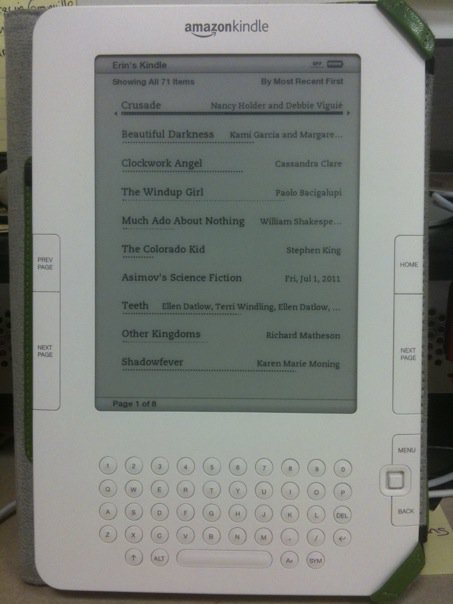
I read my first eBook that day – a Sherlock Holmes short story. I didn’t know I was in love with my Kindle until I consumed the entire Jim Butcher series, The Dresden Files in a matter of days – in less time than it took me to read the Harry Potter series. The Kindle actually enhanced my reading experience by making it easier for me to read, which allowed me to read faster and to retain more information. It was a godsend. After that, the rest was history.

Now, I am a huge – HUGE!!! – advocate for eBooks. I think they are the thing that will save the book industry. That said, I never want to lose books in print because they are just too lovely to let go. Plus, you can collect first editions for your favorite authors to sign. Fun! But back to the topic at hand, I loved eBooks so much that I jumped at the chance to make one.

Recently, Nancy Holder and Debbie Viguie approached me about turning their short story “Passing” into an eBook (which is now available online). Their vampire series Crusade had really taken off, and people were mentioning that they wanted more. So, Debbie and Nancy thought turning their short story into an eBook might be a nice way to sate their fans’ desires until the next book in the series was released (Damned) in August 2011.

As great as eBooks are to read, they don’t transfer seamlessly from a wordprocessing document format to an eBook format. If you think it’s a matter of hitting “save as” on your computer, you are mistaken. It’s not that it’s difficult to format the file for digital readers, it’s just that it is labor intensive and every character has to be formatted perfectly. You have to comb through the text, deleting extra spaces, changing tabs, setting margins, watching for odd special characters, and then verifying line by line that you have all of the italics right and that your punctuation makes sense. There are plenty of other little editing actions that are necessary to create a format that reads successfully across all (or most) eReaders. This is essential if you want to get into the premium catalog, which includes B&N, iTunes, etc., because they do not accept improperly formatted books.

So, why aren’t eBooks free? Because people have to pay someone like me to sit and pour hours into the project in order for you to download the story onto your eReader. My project was just a short story. I’m sure there are many other challenges associated with creating a novel or larger project. However, the end result is worth the time, effort, and expense.

Photo of my Kindle taken with my iPhone.

There is something wickedly satisfying about loading my Kindle with ten books that I want to read and then jetting off to London, knowing that under other circumstances I’d either be carrying a backbreaking bag of books onto the plane or I’d be stuck with a book that I might hate once I got thirty pages into the story.

When people ask me why I like the Kindle, there is too much to say without looking like I’m trying to sell them mine. So, I thought a little blog post on the joys of eBooking and Kindling might be just the ticket! If you pick up a Kindle, a Nook, a Sony reader, or some other device, I’m sure you’ll soon be singing its praises too.

Whenever I run into someone reading a Kindle I ask, “How do you like your Kindle?”

Inevitably, they answer, “I love it.”

I respond, “Me too.”

We smile, knowing that we’re not alone in our mad love for our eReaders.

Posted in Books and Literature, Uncategorized | Tagged , , , , , , , , , , | 3 Comments

Some Vampire Slayers Never Change

You got that right! Buffy and the Buffyverse are still hard at work trying to take care of people.

Please come join the Slay-A-Thon and help to support children in need. Shiai Mata from SlayerLit, a good friend of Underwords, let us know about this very special fundraising event that is being done in association with the Make-A-Wish Foundation.


9th Annual Slay-A-Thon
Make-A-Wish Foundation Benefit

Saturday, June 25, 2011
11:30 AM – Midnight
Dave & Buster’s Gold Coast – Showroom
1030 N. Clark Street (Clark at Oak)
Chicago, Illinois

From the Slay-a-thon web site:

Slay-A-Thon is a 12-hour marathon viewing of Joss Whedon’s work.

  • Buffy the Vampire Slayer
  • Angel
  • Dr. Horrible’s Sing-Along Blog

It’s a chance to meet and laugh with other Whedon fans, and have a great time while simultaneously raising money for the Make-A-Wish Foundation® of Illinois.

You are not required to attend the entire event. Stay for the day or stop by for your favorite episodes.

The best way you can help is to “sponsor” participants like Shiai Mata who have volunteered their time to attend the event and to watch hours upon hours of Buffyverse videos. It’s a tough job, but someone has to do it!

We hope that if you have a little spare change in your pocket you will be able to make a contribution in order to help their Wish Kids.

Posted in Books and Literature, Make a Difference, Signal Boost, Television | Tagged , , , , , , , , , | Leave a comment

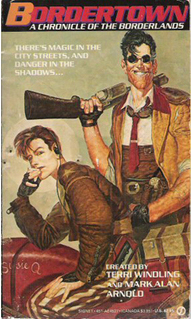
Welcome to Bordertown – The Shared World Interview!

The 1980s brought us big hair, big movies, and big possibilities. Rock ‘n Roll ruled the day. Fantasy fiction began shedding its traditional castles and bearded sorcerers in lieu of modern settings and characters, which included elves, punk rock, and everything in between. If you were looking for something new to read – something hip, something unique, something with a touch of magic – your literary compass would have sent you straight to Bordertown.

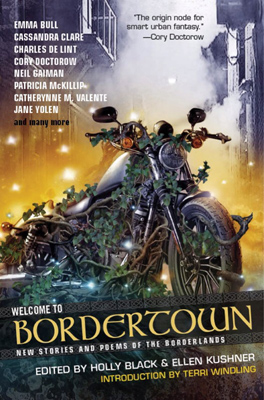
The path to that modern, magical place has opened again with the new anthology Welcome to Bordertown, edited by Ellen Kushner and Holly Black.
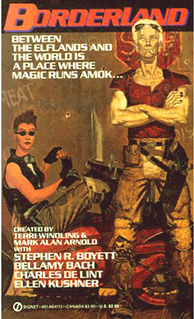
Since the series originally appeared, edited and conceived of by Terri Windling, dozens of writers have contributed to this unique shared world. Even more writers were influenced by the ground breaking stories that came out of Bordertown, and some of those writers now appear in this latest edition of the series. Following in the steps of Bordertown’s editors, Underwords has created a shared world interview, featuring eight contributors from Welcome to Bordertown.

We’re also going to be giving away an ARC of Welcome to Bordertown via Book Club on Facebook. Find out how to enter by checking their Facebook page on Saturday, May 21st! In the meantime, you can read “Shannon’s Law” by Cory Doctorow, which is posted online at Tor.com, or listen to the podcast, which is available now at Escape Pod. Also, be sure to enter the “Bordertown Lives!” Sweeptakes for your chance to win some amazing prizes.

Special thanks to all of the authors who participated in the special Welcome to Bordertown shared world interview. Enjoy!

~

What was it about the Bordertown Series that first captured your imagination?

Holly Black: There were a couple of things that struck me about Bordertown when I first read it, but the most important for me was that it suddenly felt possible to run away to a place where there were people like me, where we all loved the same books and took care of one another and where magic was finally real.  I longed for that place and my longing for it helped me to steer my way toward finding a life I’m pretty happy with.

Charles de Lint: I’m a musician and when Terri first brought up the idea of Bordertown I saw it as the literary equivelent of jamming with a group of people whose work I greatly admired. And of course the concept was a killer.
You have to remember that at the time of the first book the idea of a city full of rock’n’roll, punk elves and runaways was completely innovative. And given the paramaters of the idea I knew it would be possible to have fun as well as be able to address some serious concerns. That first book was a wonderful experience but by the second we had all hit our stride and I think it’s my favourite because everything came together in a way that’s never quite been repeated…until this new anthology.

Jane Yolen: I come out of the 60s and counter culture, live in Greenwich Village, toured around Europe and the Middle East in the mid 60’s in a VW bus, so Bordertown sounded real to me!

Sara Ryan: Outcasts carving out a place for themselves somewhere that is itself outcast. The relationships in Bordertown make me think of the chosen families constructed by people whose birth families have rejected or abandoned them, and how those families sometimes — often? — form in sketchy surroundings.

Tim Pratt: I first encountered Bordertown as a young teenager (pretty much the perfect demographic target), and was thrilled to read about a world where people around my own age had *agency* — they went off on their own, and learned about the world, and had adventures, and learned about magic, and experienced wonder and loss. There’s lots of fantasy with teen protagonists, but they often end with the teens returning to their “normal” lives — Bordertown was all about changing your life forever, and I found that tremendously exciting.

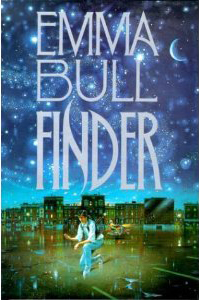
Janni Lee Simner: I got pulled in less by Bordertown itself than by the other urban fantasy books being written by Bordertown writers such as Emma Bull, Charles de Lint, and Megan Lindholm in the late 80s and early 90s. By the time I began reading Bordertown itself, the idea of bringing magic into our world–the thing that drew me to urban fantasy in the first place–was something I’d come to take for granted. So for me Bordertown was a place to find more of the sort of story I already loved, rather than something new.

Christopher Barzak: The first thing that captured my imagination in the original Bordertown Series was the complexity of the relationships between humans, the fae, and those who were born between those two worlds.  For a lot of readers, I think it was the grittiness of street life that stood out–life on the run from a world that doesn’t understand you–but in my case I was captured by the racial and class tensions that occurred on the streets of Bordertown.  Having grown up in a rural area of Ohio, where the racial and class make-up was standardized white, working class, reading about a place where race and class was more diverse sparked my interest.

Which is what made writing my story “We Do Not Come In Peace” so much fun.  I got to add to that particular thread of life in Bordertown.  My narrator comes from a white working class human background.  He’s someone who left home in the 1990s, when the border was still open, but in this anthology, because the way closed for 13 days/years, when it reopens and is filled with an influx of teenagers who have grown up in 2010 and beyond with all of their tech and coolness, he feels displaced in the one place he’d thought he could call home.  And one of those new teenagers teaches him how to fight for his place in that chaotic jumbling for power in Bordertown.

What did you enjoy most about writing your piece for Welcome to Bordertown?

Holly Black: It was amazing to get to play in this world that I had loved from the outside. My characters got to bump shoulders with the characters I’d read about and travel to the spots I felt like I knew.  Plus, since I was writing it with a friend, we got to share the experience.

Charles de Lint: Having already written a pair of novellas and a short story set in Bordertown, what I appreciated most with my piece for the new anthology was the chance to explore the events, mindset, and eventually magic that would bring a person to Bordertown.
Jane Yolen: Being able to revisit the place in a different way. I’d never written any Bordertown stories myself, but as an editor I’d edited Will Shetterly’s two Bordertown novels–Elsewhere and Never Never.

Tim Pratt: The character of Allie Land. I’ve been thinking about writing a story with her as a protagonist for literally a decade, but could never find quite the right tale for her. Turns out — that’s because she belonged in Bordertown! I just needed the opportunity to write in that world, and she sprang fully to life. I’m so grateful to Holly and Ellen for the chance.

Alaya Dawn Johnson: It took me a long time to come up with an idea I could work with, actually. Partly because everyone in the anthology had to make sure they weren’t duplicating each other’s ideas, and my first plot arc was too similar to one someone else was already working on. That was a blessing in disguise, because it led me deeper into the interesting process of rediscovering Bordertown and relating to it again as an adult. And eventually, I hit upon this exploration of family dynamics.

I love the runaways-as-family aspect of the Bordertown stories, but I kept wondering about whether I could tweak that tradition to working with something that was an *actual* family unit, albeit very non-traditional. I mean, people grow up in Bordertown, and the runaways of yesterday will eventually have children of their own. How does the child of a runaway find her own voice in the world, when she’s already living in the place disenchanted and desperate kids dream of going? When her family can be frustrating, but there’s a lot of love there, also? Writing about that felt true to Bordertown and also like my own special place in it, which was very rewarding.

Janni Lee Simner: I enjoyed so many things it’s hard to know where to begin! It was fun getting to see what happens when current urban fantasy meets the urban fantasy of 10 or 20 years ago (among other things, they go out dancing together); it was fun imagining what Bordertown mean to those yearning for fantasy in my own city (which is just an hour from a border of its own); it was fun collaborating with all the other Bordertown writers and finding all the intersections among our stories (one of my newbie characters does some serious–if fleeting–crushing on Wolfboy).

What do you hope new Bordertown readers will take away from their experience with Welcome to Bordertown?

Holly Black: I hope they’ll love it the way that I do and be inspired by it the way that I was.  I hope they see themselves there.

Charles de Lint: The joy with which we all approached our stories. I’m not sure who had more fun: the old-timers returning to familiar haunts to find that, while some things had changed, the essence of Bordertown hadn’t; or the newcomers arriving for their first visit. Dark or light, complicated or simple, I think these stories brought out the best in us and I know that I thoroughly enjoyed reading each offering whether it was prose, poetry or comic book.

Jane Yolen: I hope it becomes an indelible and iconic place for them, their generation’s Narnia or MiddleEarth.
Janni Lee Simner: Well, first I hope they have fun! But beyond that, the sense that maybe the world really is filled with magic, and the hope that–like the characters in the stories, each of whom gets to Bordertown in his or her own way–we can each find our own magic in our own ways, too.

Christopher Barzak: I hope readers can take away something similar to what I did as a teenager discovering the series for the first time:  a piece of themselves that they hadn’t recognized until they saw it lying in the streets of Bordertown.

~

For more Bordertown fun, be sure to check out the Bordertown Web Site.
Welcome to Bordertown will be released on Tuesday, May 24, 2011.

Posted in Books and Literature, Fantasy, Fiction, Interviews, Uncategorized | Tagged , , , , | 5 Comments

Review: Teeth, editors Ellen Datlow and Terri Windling

Editors: Ellen Datlow & Terri Windling
Publisher: HarperCollins
Print Date: April 5, 2011
ISBN-13: 978-0061935145
Details: 480 pages | paperback | $9.99

~

The new anthology TEETH, edited by Ellen Datlow and Terri Windling, includes a delectable assortment of bite sized vampire stories that should be tasted and savored. Yes, all of the stories are that good. One of the best things about TEETH is that the stories consistently establish strong, unique worlds filled with characters who are compelling and interesting. Plus, you’re sure to find a few new vampiric details and treasures that are not part of the standard mythology in today’s vampire literature.

While the stories differ in voice, tone, and style, they each offer something significant and unique for readers to  enjoy. Tender friendships, lost potential, arranged marriages, fights for survival, and coming of age stories are just a few of the themes within this anthology. Some stories will stick with you well beyond “The End,” especially the stories that should only be read in full daylight. While all of the stories are good reads, there are several stand outs. A few of those standouts include, but are not limited to:

Things to Know About Being Dead by Genevieve Valentine is a touching story about a newly undead girl who is learning the ropes of her new undead existence with the help of a ghost and her aging grandmother. This is one of two stories that are available online as a free preview.

All Smiles by Steve Berman is also available online as a free sample. After reading All Smiles, you will think twice about hitching a ride from someone with a perfect pearly white smile. This fight for survival story will have you cringing and running for the door.

Vampire Weather by Garth Nix brings an interesting spin on the world after vampires make themselves known. When the fog comes rolling into one of the remaining pockets of pure human societies, a young man learns the truth about vampires and the world that could either kill him, set him free, or both.

Sit the Dead by Jeffrey Ford is an inventive story with a new twist the blends old cursed bloodlines, modern day family responsibilities, and ultra creepy vampires. Long after the story is over, the ending will stick with you as you wonder whether or not the story ended “right,” and you will inevitably keep coming back to the same conclusion. It couldn’t have ended any other way. The real question is what happens next.

Sunbleached by Nathan Ballingrud brings the vampire back to bad. Dark and dangerous, the beautiful imagery used to compare the hideously burned vampire is reminiscent of a  graceful caged spider ready to pounce.

The Perfect Dinner Party by Cassandra Clare & Holly Black is a superbly written story about a brother and sister pair of vampires who struggle to find how they fit into the world and with each other – all told against a backdrop that reads like a clever Miss Manners guide. It’s rare to find such an exquisitely told story written in second person. It’s a must read.

Why Light? by Tanith Lee is a lovely story about two young vampires from vastly different families who are forced into an arranged marriage. There is a strong sense of new and old world coming together in Why Light. This convergence of old and new, light and dark, evil and good plays with parallels inherent in both historical and contemporary vampire fiction in an interesting way.

All in all, Terri Windling and Ellen Datlow built a wonderful collection of stories that is a true pleasure to read. As sweet and tender as some of the stories are within TEETH, you may need to keep the light on for a few of the darker pieces. TEETH is an anthology that will keep you coming back for more, story after story until the last page is turned.

THE END

Posted in Horror, Reviews, Uncategorized | Leave a comment

New Writer Spotlight: Kevin Hearne

This New Writer Spotlight features The Iron Druid Chronicles author Kevin Hearn. He enters the publishing world with his first novel Hounded, which releases on May 3, 2011. You can find Kevin online at his author website, on Twitter, and on Facebook.

~

Kevin Hearne is a native of Arizona and really appreciates whoever invented air-conditioning. He graduated from Northern Arizona University in Flagstaff and now teaches high school English. When he’s not grading essays or writing novels, he tends to his basil plants and paints landscapes with his daughter. He has been known to obsess over fonts, frolic unreservedly with dogs, and stop whatever he’s doing in the rare event of rain to commune with the precipitation. He enjoys hiking, the guilty pleasure of comic books, and living with his wife and daughter in a wee, snug cottage.

~

What is your first published novel? What’s it about?

HOUNDED is my debut, featuring a 2,100 year-old Druid living among us who’s been on the run from Irish gods for much of that time. The novel picks up where he basically decides to stop running and fight. All pantheons are alive and well and trying to make their way in this secular, scientific age—and most of the monsters and boogeymen are too. I had lots of fun with mythology, taking it back to its roots and stripping away the sugary layers that Disney has painted on top of it.

What were some of your biggest challenges with Hounded during the writing process?

Irish words are tough both to spell and pronounce and can cause severe issues with one’s self esteem. Sifting through loads of myth and deciding what to keep and what to throw away was almost a labor of Hercules, but I’m well.

Do you have a favorite scene or character that you most enjoyed writing?

I loved Oberon, the talking Irish wolfhound—still do. He’s such a fun fella, and most of my early reviewers indicate that he’s their favorite character to read.

What other novels and/or short stories have you published? What are
you working on now?

Hounded is my first published work, but it’s going to be followed up very quickly by Hexed on June 7 and Hammered on July 5. Right now I’m working on book four of The Iron Druid Chronicles, called Tricked.


How would you describe the type of fiction that you write? What is it about this type of fiction that you enjoy so much?

I write urban fantasy, but I’d like to stress that very few of my characters wear leather pants. I enjoy the genre because the possibilities are so enormous—take any mythology or critter from folklore and drop it into the modern world, then watch everything go crazy from there.

Do you have a mentor or another writer who helped to guide you through your writing process or with developing your career? Who do you turn to for advice?

Nicole Peeler and Kelly Meding have been fabulous to me ever since I signed my deal. Once I joined The League of Reluctant Adults, I had an even larger group of authors to turn to when I had a question or just needed therapy. I’ve been very fortunate.

It is said that learning to write well is like experiencing a series of never ending writing related epiphanies. If you had to pick one, what is the most important lesson you have learned, so far?

Don’t give up. It took me 20 years of trying, but I’m finally getting published.

When did you first know that you wanted to write? What inspired you to tell stories?

I first figured it out at age 19. I read One Flew Over the Cuckoo’s Nest and was so inspired by that voice, and by the message that we need to hang onto our sense of self in a society that would have us conform.

Which authors, stories, or novels most affected your development as a writer?

Besides Ken Kesey, I’d say Neil Gaiman, Neal Stephenson, and William Gibson. All of them are great stylists and tell brilliant stories.

What kind of writing related education have you received? How do you think it has helped or prepared you for your own writing?

My education trained me to be an English teacher, so it prepared me more for essay writing than for fiction. The most valuable education you can receive in writing is to read a lot. The more books you read, the more plots and words you’re putting into your noggin so that you can rearrange them all in fabulous new ways. So every author I’ve ever read helped me become the author I am today.

~

Read the first opening chapters of HOUNDED before
the book releases on May 3rd.

Posted in Books and Literature, Fantasy, Fiction, Interviews, Uncategorized, Young Adult Literature | Tagged , , , | 5 Comments

One Word Interview: SILENCE

April’s One Word Interview is doing something different this month. We’re exploring a word that makes no sound through two separate interviews: Images and Words.

The One Word Interview has gathered a host of dark fiction and horror writers to participate, responding in 50 words or fewer to the word SILENCE. As we move from winter to spring, let us pause, taking a moment to listen to the sounds or lack thereof that surround us. What truths and what meanings can we find in SILENCE?

~

Silence – what you really hear when the goldfish die – the notes Miles Davis and Bill Evans did not play—and the length of time they did not play them – the poetry of Bill Wantling and his lines “It’s cold for August” and “How far to the next enemy camp …” and for me, the technique learned from the folks mentioned … when I discover the silence and use it right in my work, it’s that moment of held breath in a story … or after it …
Mort Castle

Silence

Silence=death is the slogan created by six AIDS activists in 1987

Silence=death for the vulnerable whether they are women with no voice in societies where women have no rights or children in the US with abusive parents or caretakers.

Silence is the unnatural quiet of a dark street, a dark forest, a dark place. Silence is where horror grows.
Ellen Datlow

Silence: It escapes me, always. And were it not to escape me, it would terrify me. There’s no silence, not here inside my head. White noise and broken calliopes and shattered bottles, but no silence. If silence has a smell, it must be a sharp smell, like kerosene. We keep each other at arms length, silence and I. And if I believed in Hell, I would imagine it a very silent place, absolute zero.
Caitlín Kiernan

Silence is the page, backstage before the curtain rises.
Kathe Koja

.

.

If SILENCE is golden, I’m not interested. SILENCE is silver. A slivered moon alone in a darkened, cloudless sky. The lonely knife blade, honed, piercing flesh. Chains, crosses, metal studs cutting the night. Silverweeping silently. It always has.
Nancy Kilpatrick

SILENCE
When the subway stops, and the lights wink out, there’s a moment of silence no New Yorker dares to shatter. Thick-fisted dark and all the geologic layers squeeze: between each breath, only eternal void. And the lights burst on and the train moves forward, a little of us left behind.
Livia Llewellyn

Silence, silence—it’s one of those words that gets louder when repeated. What are we supposed to talk about here as horror writers? The silence before the floor begins to creak in the night or some other cliché? I’m more interested in that old critical turn of phrase: a writer who “falls silent”, which means that they either no longer publish or can no longer be published. What a relief it would be to be able to fall silent, to have written something that will actually stay in print, perhaps even provide an annuity through backlist sales or frequent reprinting in a textbook. Ah, and to write something that doesn’t turn embarrassing two or five or ten years later, to come up with some literary trick that doesn’t get old after a single performance. Then I could be silent, then I could choose silence. SILENCE SILENCE SILENCE, shout it from the rooftops! If only!
Nick Mamatas

Silence happens in the in-between, that moment when noise fades away. When scuba diving, the magic of whale song is heard in-between the raspy intake of breath and the explosive bubbles of an exhale. In meditation, God speaks in-between the noise of everyday thoughts. In silence exists all the wonders of the world.
D. Lynn Smith

Silence is something fiction could use more of—those reflective rests in which a character discovers his or her new context. As a writer I crave it—it’s what I need to do my work. As someone who is aging, and seeing friends dying, it’s what I dread.
Steve Rasnic Tem

Silence is my father, refusing to acknowledge my existence, refusing to react either to my happiness or anger. He shuns, ignores, and rejects me. And silence is how I will answer the news of his eventual death.
Matthew Warner

.

I need silence to live. In silence, I hear the universe, hear my heartbeat, listen to life. I am relaxed. I am present. I am full of energy, ready to fill that silence with thoughts, words, images. In silence, I am me.
Morven Westfield

.

Be sure to also view the companion interview,
The One Image Interview: Silence

Posted in Uncategorized | 2 Comments